
Texas schools receive A-F accountability grades as more districts hope to avoid takeovers
By Sneha Dey, Jaden Edison and Rob Reid, The Texas Tribune
August 14, 2026
Texas’ school performance ratings remained relatively flat this year, while the Austin school district prepared for expected state sanctions over chronic F ratings.
Campuses and districts received their state report cards Friday, providing families a glimpse of how well schools educate students. About one in four schools saw their ratings improve, while a nearly similar number of campuses saw a drop.
Of the more than 9,000 campuses in the 2025-26 school year, 24% scored an A, 34% scored a B, 23% scored a C, 10% scored a D and 4% scored an F. Some schools did not receive grades.
Schools with high poverty performed worse than more affluent campuses, while campuses with predominantly Black or Hispanic students scored lower than those where white or Asian students make up the majority.
Still, Texas Education Commissioner Mike Morath characterized the ratings as a win, pointing to the hundreds of campuses in high-poverty communities that earned an A.
“We are teaching them handwriting. They are memorizing the timetables. They are thinking through more and more advanced math problems. All children can learn and achieve,” Morath said as he visited a New Braunfels campus Friday morning.
Because two Austin middle schools earned their fifth consecutive failing grades, the threshold for the state’s most severe sanctions, Morath must decide between shuttering the campuses and replacing the district’s locally elected school board with appointees he selects.
AISD Superintendent Matias Segura told the Austin Current he has not communicated with state officials regarding the commissioner’s plans for the district.
“I understand there is an anxiousness and concern in the community,” Segura told the Current. “We are going to be here tomorrow, the teachers are going to show up, we are going to do the work to ensure their student gets what they need, regardless of what that looks like for that specific family, for that specific school. AISD will continue to be here; we have been here for 145 years.”
The letter grades campuses receive can shape community perceptions. Often, parents use the scores to pick a school for their kids. Businesses may also weigh the ratings when choosing which regions to invest in or move to, as they anticipate that schools labeled high-performing will graduate more students prepared for the workforce.
Ratings for schools and districts largely depend on three primary metrics: how students perform on STAAR and meet college and career readiness benchmarks; how results on state tests improve over time; and how well schools educate underserved children.
Bridget Worley, the chief of statewide impact at Commit Partnership, said grades stagnated this year partly because of how the Texas Education Agency measures growth.
“In the districts that are evaluated on growth, we see fluctuations in performance,” Worley said. “It is rare to actually see giant jumps in performance year over year. You can have a really high growth year that is hard to sustain.”
Critics of the state’s accountability system say school ratings fail to account for the challenges facing high-poverty schools, which often work with fewer resources to serve children with higher needs. They say it pressures districts to focus more on improving their letter grades than helping students grow academically.
Proponents of the grades say Texas families deserve transparency about how well schools educate their children. Worley, an advocate for accountability grades, said ratings are a way to help low-income schools access more resources.
“It is possible for all campuses in Texas to earn an A or B,” Worley said. “But it takes dedicated systemic decisions to bring in those resources and that talent.”
Some districts stave off state takeover. One falls short.
Texas has increasingly leaned on state takeovers as a way to fix chronic academic struggles. But a handful of districts on the brink of intervention this year — Ector County, Greenville, Ralls and Spring — managed to narrowly avoid Austin’s fate with gains at their struggling campuses.
Waco inched closer to a takeover with a failing grade at one elementary campus this year, but the district’s partnership with charter network Third Future Schools buys them more time before they hit the threshold.
Austin became vulnerable to a state takeover earlier this year after the state rejected the district’s bid to enter a partnership similar to Waco’s move. Agency officials said the nonprofit wanting to step in, Texas Council for International Studies, did not have a proven record of academic turnaround.
Now, Austin students, parents, educators and local advocates await news on whether the state’s education chief will replace their elected trustees. Districts have until Sept. 11 to appeal their grades to the Texas Education Agency.
Texas schools that trigger state takeovers tend to serve predominantly Black, Latino or low-income students. That remains true for the two Austin campuses that received their fifth F ratings on Friday.
“We know the state takeover playbook,” Ken Zarifis, the president of Education Austin, a local teachers union, said in a statement. “We just hope they won’t run it in Austin ISD.”
How districts under state control over fared
Two of Texas’ largest school districts, Houston and Fort Worth, have state takeovers well underway. Students are seeing aggressive changes because of the intervention, including teacher departures and scripted classroom lessons.
Three years after Houston’s takeover, the campus that triggered the takeover, Wheatley High School, received an A.
The state’s largest district, however, slipped in some ratings, going from no F-rated campuses last year to five this year. One of those schools did not previously receive a rating.
Critics often point to high teacher turnover, declining enrollment and an overemphasis on testing as evidence that the takeover harms students. They express concerns about district officials moving children to less rigorous courses, which some consider proof that letter grade increases do not equate to meaningful learning.
“People should be asking why the scores move up and down all the time,” said Ruth Kravetz, co-founder of the Houston-based Community Voices for Public Education. “Bad things are happening to make the ratings look good.”
Morath replaced Fort Worth ISD’s leadership this spring, about two weeks before most STAAR testing began. Before then, former superintendent Karen Molinar shifted instruction to improve outcomes. The district went from 39 D and F rated campuses last year to 26 campuses this year.
“We are pleased by these results,” said Zach Leonard, a Fort Worth parent who leads a coalition of families organizing against the takeover. “Ratings don’t just define people in a district the way that the state wants to. But these improvements are a direct reflection of Dr. Molinar and her staff.”
The commissioner also took over the Beaumont, Connally and Lake Worth school districts earlier this spring. It’s too early to assess the impact of the takeover in those communities.
Lake Worth had one F school this year, down from five last year, which included an early childhood campus whose rating was paired with another.
Beaumont had 11 schools failing the standards, compared to three last year. Connally had one F school in 2025 and four this year, including an early childhood campus that’s paired with another school.
For one district, a long-awaited pay off
Student cheerleaders and teachers packed the cafeteria in Oak Run Middle School to celebrate the New Braunfels campus’ jump from a C to an A. The wins come even as teachers said they must manage growing class sizes.
“You are one of the few schools that saw this amount of gain in one year,” Morath said. “And this happens because of extraordinary leadership. It happens because of an extraordinary staff that buckles down, that focuses on the fundamentals.”
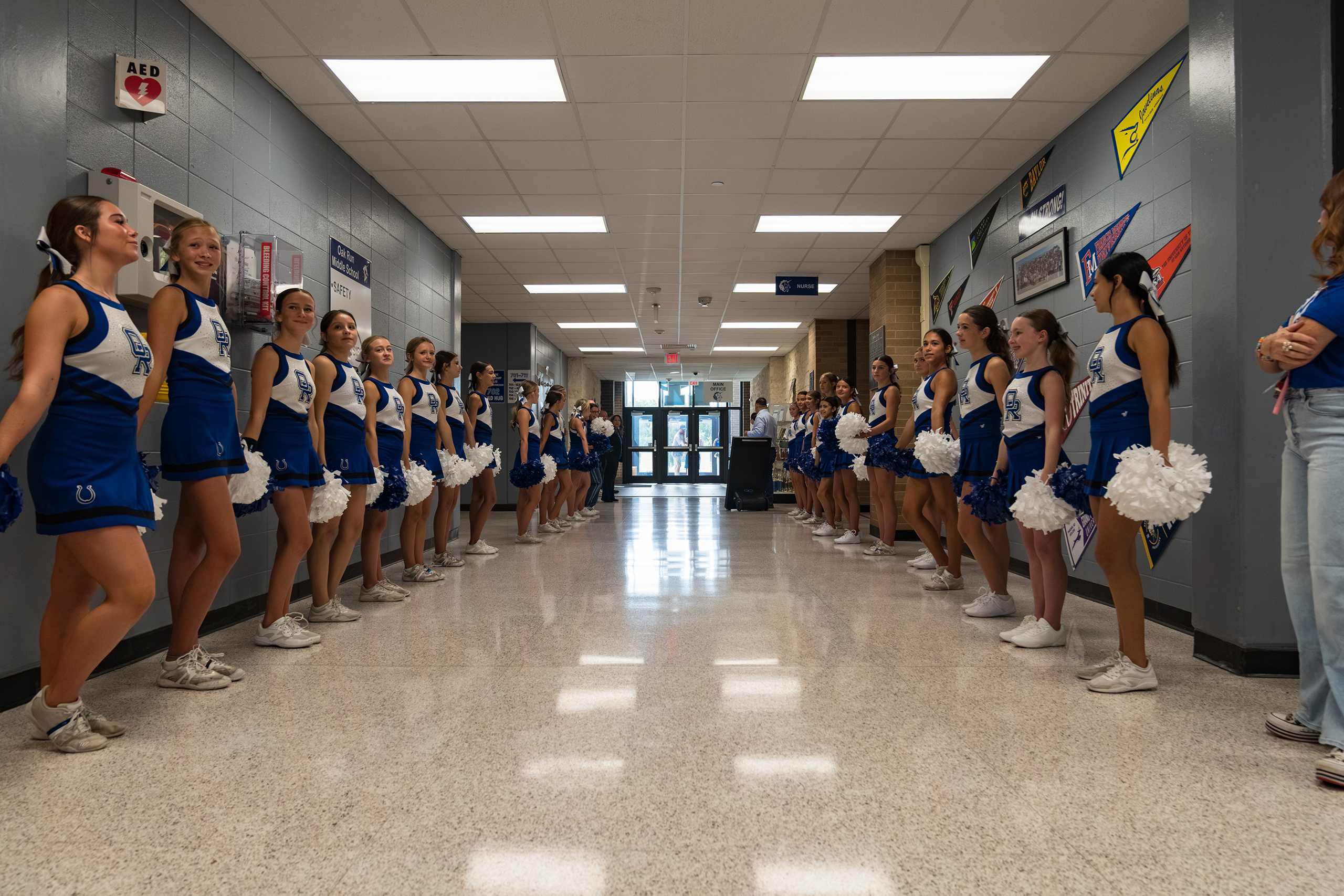

Jessica White, the former principal of Oak Run Middle, credited the gains in academic achievement to providing additional tutoring to students as often as every six weeks and helping new teachers deliver lessons effectively the first time.
“We showed students if they could prove themselves, they could move into something fun,” said White, of offering small rewards such as popsicles or recess to students doing intervention work. When educators followed through on their promises of rewards, “they felt more powerful. It really does matter.”
This article first appeared on The Texas Tribune.