MICHAEL SENDIVOGIUS: FATHER OF OXYGEN RESEARCH
******************************
MICHAEL SENDIVOGIUS: FATHER OF OXYGEN RESEARCH
by JAMES A. MARPLES
******************************
Comparatively few people have heard the name Michael Sendivogius; yet, his contributions into the field of Oxygen, were of immense importance and the relevancy of his studies continue to this very day. He was born on the 2nd of February 1566 at either Skorsko or Lukawica, Poland; and died at Cravar, Silesia, in June 1636. Cravar is approximately 9 miles east of Opava, in the modern-day Czech Republic. His parents Jacob Sedzimir and Catherine Pielsz Rogowska were both of noble families and had a small estate near Nowy Sacz, in the Cracow district of Poland. It is reported that young Michael traveled to and studied at (or at least visited) universities at Moscow, Russia; Sweden; England; Spain; Portugal; Italy where he studied the rare works of Paracelsus in The Vatican Library; Greece {where he was instructed by a patriarch of the Greek Orthodox Church}; and Constantinople (now in modern-day Turkey). At this same time he was studying philosophy, medicine, rhetoric, Geometry, astronomy, mechanics, theology, and other subjects at the Universities of Cambridge, Frankfurt, Rostock, Wittenberg, Leipzig (in 1590), back to the University of Vienna (1591), and the University in Altdorf in 1594-95 and also Ingolstadt (both in Germany), in Prague (in today’s Czech Republic). It is notable that one of his fellow students while at Altdorf was Michael Maier, another confirmed Rosicrucian. For that time-period, Sendivogius was an exceptionally well-traveled man.
Michael met up with the Polish head of heraldry, Bartlomiej Paprocki, who convinced him to change his surname to a more nobler-sounding name of Sedziwoaj (sometimes spelled Sedziwoj). The Latin equivalent was Sendivogius, and Michael began to sign his name with a flourish as “Michael Sendivogius Liberbaro de Skorsko et Lukawica”. He was a friend of Rudolf II of Prague, who considered him a trusted and beloved friend. Gradually, Rudolf II became his benefactor. In a fairly short time, Sendivogius rose from being a courier to a King’s secretary, to a confidant , to eventually, an imperial privy councilor. As an imperial official, he visited even more universities, such as the University of Altdorf, where his name appears in the year 1595.
Sendivogius married a wealthy widow Veronika Stieber and had four children. Sendivogius was devastated when his wife and two of their four children died during an epidemic. He felt he had been abandoned by Rudolf II of Prague; so Sendivogius returned to Poland. While there, he helped establish iron and brass foundries in Krzepice, Poland. Then, he helped establish lead foundries in Silesia. For his long years of under-paid (or even unpaid) services: Sendivogius was granted small estates in Moravia (in today’s modern Czech Republic).
The study of alchemy reached its apogee in the 17th Century in Prague {now in the Czech Republic}. The miners and refiners were aware that lead ore often contains some silver ore; and that silver ore usually contains some gold. This suggested to the early alchemists that metals gradually changed into another over time. Because gold was resistant to tarnish and corrosion, that suggested to them that gold was the summit or ending-point of this evolutionary process.
Michael Sendivogius and other early alchemists saw that two elements ‘mercury’ and ‘sulfur’ as the hinge by which they felt opened the door to alchemical conversion. For instance, too much of the fluid mercury was present in tin and lead. Too much sulfur was present in hard metals such as iron and copper. Gold, seemed to them, to be the perfect admixture. Hence, turning one metal into another required adjusting the mixture very carefully with precise mixtures of mercury and sulfur. This evolution might take thousands of years for the ore beneath the earth to evolve or transform. Alchemists wanted to speed-up the process by tossing molten metal onto what they called the Philosopher’s Stone. Having a cloistered sense of protecting their coveted formula, early alchemists often wrote each other in riddles, rhymes, and codes which required a cipher to translate. They were either paranoid or extremely sensitive that their closely-guarded formula be kept secret. Yet, despite critics assertions: most alchemists regarded their discoveries to be, ultimately, of Divine origin. Nearly all had reverence toward Almighty God as the Creator and Preserver of all things. They simply felt they were unveiling a new discovery of describing an aspect of God’s Creation. Furthermore, they intensely desired to keep their identity secret. They sought anonymity { or at least pseudonyms, such as the quasi-ANAGRAM Sendivogius used at times: Divi Leschi Genus Amo” } because The Church during that era was inclined to persecute what it believed to be any authors of heretical publications. In later centuries, alchemists gained a more respectable position in society’s hierarchical ladder, since most were Medical Doctors, Scientists, Philosophers — or all three wrapped inside a single person. Professor David C. Poole, a professor currently teaching at Kansas State University in Manhattan, Kansas states: “I do think that the alchemists have been given short shrift through the centuries and that some may have been gifted chemists”.
Michael Sendivogius was such a man. Sendivogius tried to promote a so-called secret society of “Unknown Philosophers” of which he drew-up the Statutes. Even ordinary citizens couldn’t help but see the resemblance of Sendivogius’ Society with the Society of the Rose & Cross {Rosicrucians} which was founded by Fr. Christian Rosenkreutz. The resemblance was remarkably uncanny. Most importantly– “
John French worked in alchemy himself, and he published books on the subject himself in London circa the year 1651. John French spoke of Michael Sendivogius’ belief in “many men of a good conscience” and he enumerated key points which I will only briefly summarize here:
* The most important elements of study {Medicine/Science/Philosophy}
* Diligently read the sayings of the old philosophers. Compare them with others. Verify what has been expounded. “Where they have erred— do beware”. and keep studying until you find that “sweet harmony” of logic, truth, and Faith.
* Work Diligently.
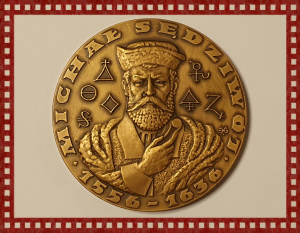
I recently came across a bronze medal which depicts the likeness of Michael Sendivogius (the same image as at the Top of this presentation). While some ‘symbols’ are well known; others are somewhat obscure. Beginning on the left side of the medal, the symbol of a cross-atop-a-triangle is the symbol for ‘phosphorus’. The symbol of the circle with a line dividing it in twain is the symbol for ‘salt’. The diamond-shaped symbol {almost akin to a square tilted-on-its-end is the symbol for ‘Antimony’ or ‘soap’. The most elusive medal for me to identify was the bottom left side symbol that looks like a Capital ‘S’ with two transverse-bars drawn through it. With the aid of Prof. Claire Fanger of Rice University, she correctly identified that as the symbol for “Precipitated Mercury”.
Now, for the symbols to the right side of the medal —from Top downward — next to the “Z” of SEDZIWOJ’s name is also another symbol for “Precipitated Mercury”. The symbol which looks like a Triangle with a cross beneath it, is the symbol for “Sulfur”. The last symbol which looks like a lazy Capital “Z” with a tiny slash crossing the lower bar is the symbol for “Tin”.
On the bronze medal Michael Sendivogius has his name spelled as MICHAL SEDZIWOJ 1556-1636. {Interestingly, the bronze medal indicates his year of birth as 1556 contradicting most sources which cite the year of 1566. He is depicted as a wise, old bearded gentleman, wearing a rounded-crown cap, with its totally encircled, folded-upward brim.
The superficial aim of ancient alchemists was their hope to turn base metals into gold. I find it quite interesting that the symbol for ‘gold’ is literally a ‘Point-within-a-Circle”. And that the symbol adopted for ‘silver’ is a “Crescent”. The four (4) major Elements, Earth, Air, Fire, and Water each have a Triangle… with various adjustments to correspond with each differentiating characteristic. {See EXHIBIT B, below}.
The noted Masonic scholar, Dr. Albert G. Mackey, M.D., noted that the Elements were a “doctrine of the old philosophers, sustained by the authority of Aristotle that there were four principles of matter — fire, air, earth, and water — which were called Elements”. He noted that modern science has discovered many fallacies promoted by “Cabalists”. However, Mackey acknowledged that more of the virtuous aspects of elemental-science were promulgated by the Rosicrucians into several Masonic Degrees. Various angels of the four elements described as Andarel, the angel of fire; Casmaran, of air; Talliad, of water; and Furlac, of earth, and the signs refer to the same elements”.
Michael Sendivogius {or Sedziwoj} had his greatest achievement by promoting his belief that air {Oxygen} is the “hidden food of life”. He noted that although ‘invisible’, it had life-giving properties. He studied potassium nitrate as well as ammonium nitrate. His studies led other researchers into continuing his research into areas of air and combustion. Sendivogius traveled to most areas of Europe. He was even accused of being a spy; yet he seems to have been more a scholarly drifter and diplomat, rather than a secret double-agent. His studies into Oxygen seem relatively commonplace to us, as scholars now in the 21st Century. However, in the early 17th Century, Sendivogius was putting a written name to elements of Nature that were shrouded in mystery. Even the Element of “Water” although seen as rain, even back then, was not known except by a few scientists to consist of two parts Hydrogen and One part Oxygen. Symbolized by: H2O .
Michael Sendivogius emphasized that oxygen is “vital air”. Many subsequent scientists took Sendivogius theories and amplified them in new and diverse ways: In the year 1891, the Scottish chemist Sir James Sewar {who is better known as the inventor of today’s modern “thermos-bottle”}, discovered that oxygen is magnetic. He maintained this is caused by the spin of unpaired electrons in the outer electron orbit, and this makes it difficult to form new chemical bonds.
I was amazed recently to learn of a man whose life overlapped that of Michael Sendivogius, the alchemist, Thomas Henshaw (1618-1700), (who oddly enough was a clergyman with a wonderful imagination . . to use an organ-bellows) to formulate a primitive Hyperbaric Oxygen Therapy device.
In the 20th Century discoveries were made were hyperbaric oxygen therapy and treatment chambers to pump force oxygen into the body at levels greater than normal atmospheric pressure. These HBOT procedures have been found successful speeding-up wound healing, treating gangrene, and victims of carbon-monoxide poisoning. A patient may for a period of time breathe-in 100% pure oxygen, and then have momentary breaks to breathe-in “room air’ (21% oxygen) to reduce the risk of oxygen toxicity. Blood oxygenates in the lungs and oxygen clings to red blood-cells which is then carried via blood vessels to various tissues of the body, to thus enable various organs of the body to continue functioning. In a different contrast, studies have shown that the ratio of pure oxygen to normal air has to be delicately precise, especially with newborn infants.
I was able to get some additional information from The Krajmed Medical Center in Warsaw, Poland (in February 2026). They state that their HBOT treatment center “delivers increased Oxygen to diseased and Hypoxic tissues and organs; improves blood-circulation; slows down the aging process; accelerates the elimination of carbon monoxide; improves the ability to remember and concentrate; has a bactericidal and bacteriostatic effect; and improves sexual performance”. I also contacted Miliana at the “House of Salt” health spa in Denmark, and she reports: : “HBOT works by allowing you to breathe nearly 100% oxygen under increased pressure. This causes a much higher amount of oxygen to dissolve directly into the blood plasma. As a result, oxygen can reach tissues that are inflamed, swollen, infected, or where circulation is reduced — including delicate structures in the eye.
This is particularly important because the retina and optic nerve are among the most oxygen-dependent tissues in the body. In several eye conditions, the underlying issue is not only inflammation or infection, but also a lack of sufficient oxygen reaching the tissue.
All-in-all, from human and animal breathing, to welding, to furnaces and air-conditioning. to medical-devices –OXYGEN is vital to our lives. All of this proves that one man’s discovery centuries-ago still makes a big difference.