
UT Health Tyler Successfully Implants TriClip, First-of-Its-Kind Device to Repair Leaky Tricuspid Heart Valve
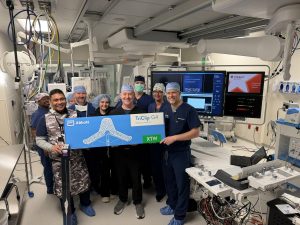 Tyler, Texas (March 3, 2026) — The interventional cardiology team at UT Health Tyler announced that they have successfully performed their first procedure using the Abbott TriClip transcatheter edge-to-edge repair (TEER) system, the first-of-its-kind device to repair a leaky tricuspid valve (known as tricuspid regurgitation or TR).
“The ability to offer the TriClip TEER system marks a significant advancement in how we care for patients with tricuspid regurgitation,” said Dr. Ajay Pachika, board-certified interventional cardiologist with Tyler CVC Cardiovascular Consultants (CVC), who performed first TriClip procedure. “For many patients, traditional surgery has not been a viable option due to the associated risks. This minimally invasive approach allows us to effectively reduce regurgitation, improve symptoms and, most importantly, enhance our patients’ quality of life.”
TriClip is delivered to the heart via a catheter inserted through the femoral vein in the leg and works by clipping together a portion of the leaflets of the tricuspid valve to reduce the backflow of blood. Designed specifically for the right side of the heart and the tricuspid valve’s complex anatomy, the innovative TriClip and steerable guiding catheter systems allow physicians to independently grasp and effectively clip leaflets of the tricuspid valve to reduce the regurgitation. This minimally invasive approach allows the heart to pump blood more efficiently and relieve symptoms of TR, which improves the quality of life for patients.
Tricuspid valve regurgitation is a condition in which the valve between the two right heart chambers (right ventricle and right atrium) don’t close properly, allowing blood to flow backward into the right atrium of the heart. The disease is often debilitating, causing symptoms such as shortness of breath and fatigue, and when left untreated, may progress into conditions such as atrial fibrillation (AF), heart failure and, ultimately death.
Traditionally, the only treatment options for TR have been surgery, which is rarely performed due to the complexity of the procedure and high risks involved, and medical therapy, which is usually not successful in reducing TR. Abbott’s TriClip device provides a much-needed treatment option for people suffering from this condition.
“Tricuspid regurgitation has historically been underdiagnosed and undertreated, yet it can have a profound impact on a patient’s daily function and long-term health,” said Dr. Brent Davis, cardiologist with CVC. “With the recent FDA approval of Abbott’s TriClip system, we are now able to provide a safe, catheter-based therapy specifically designed for the tricuspid valve’s complex anatomy, giving new hope to patients who previously had limited treatment options.
“This milestone further expands our growing structural heart program, which now includes TAVR, MitraClip and Watchman,” he added.
About UT Health East Texas
UT Health East Texas provides care to thousands of patients each year through an extensive regional network that includes nine hospitals, more than 90 clinics, the Olympic Plaza Tower, 13 regional rehabilitation facilities, two freestanding emergency centers, regional home health services, an EMS fleet of more than 65 ambulances and four helicopters, and a comprehensive eight-trauma center care network, including the region’s only Level 1 trauma facility.
As a partner with The University of Texas System, UT Health East Texas is uniquely positioned to provide patients with access to leading-edge research and clinical therapies while training and educating the next generation of physicians and other health professionals. The nationally recognized UT System also includes The University of Texas MD Anderson Cancer Center in Houston, The University of Texas Southwestern Medical Center in Dallas, as well as three other major university medical centers located throughout the state.