
UT Health East Texas EMS earns award for dispatch excellence
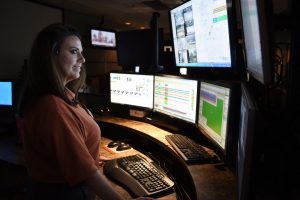
Sheree Hand, a UT Health East Texas system status controller, dispatches calls at EMS headquarters in Tyler.
Tyler, Texas (August 29, 2024) — UT Health East Texas EMS has been recognized by The International Academies of Emergency Dispatch (IAED) as an Accredited Center of Excellence (ACE) for emergency medical dispatching.
IAED is the standard-setting organization for emergency dispatch services worldwide. Accreditation (and subsequent re-accreditation) from the IAED is the highest distinction given to emergency communication centers, certifying that the center is performing at or above the established standards for the industry. Centers who earn ACE status are the embodiment of dispatch done right, and have demonstrated strong local oversight, rigorous quality processes, and a commitment to data-driven continuous improvement.
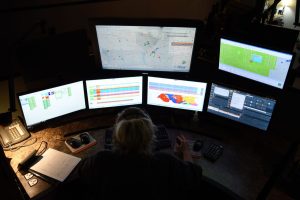
Kristy Brock, a UT Health East Texas system status controller supervisor, surveys multiple monitors while dispatching calls at EMS headquarters in Tyler.
“Being recognized as an Accredited Center of Excellence by the International Academies of Emergency Dispatch is a testament to the unwavering dedication and expertise of our team,” said John Smith, CEO of UT Health East Texas EMS/AIR 1. “This prestigious accreditation reflects our commitment to providing the highest standard of emergency medical dispatch services, ensuring that our community receives the best possible care during critical moments.”
IAED will present UT Health East Texas EMS with an Accreditation plaque that commemorates their achievement. IAED Accreditation is the culmination of a lengthy, arduous process that includes the completion of the 20 Points of Accreditation, a detailed evaluation of performance by industry experts, and a final review and ruling by IAED. UT Health EMS has been ACE accredited since 2012.
“Accreditation is truly a pinnacle achievement,” said Christof Chwojka, Accreditation Board Chair at IAED. “We applaud the dedicated call-takers, dispatchers and leadership team at UT Health East Texas EMS for their commitment to quality, and for meeting that high standard that few achieve. We know their community can count on these first, first responders to do an outstanding job.”
Accreditation is valid for a three-year period, during which all standards must be upheld. Over 3,500 emergency communication centers worldwide use the medical, fire, police and emergency nurse triage protocols developed and maintained by the IAED. The protocol-based system — known as the Priority Dispatch System — is recognized as the standard of care and practice for emergency dispatch, and is used in 46 countries.
Cutline 1: Sheree Hand, a UT Health East Texas system status controller, dispatches calls at EMS headquarters in Tyler.
Cutline 2: Kristy Brock, a UT Health East Texas system status controller supervisor, surveys multiple monitors while dispatching calls at EMS headquarters in Tyler.
About UT Health East Texas
UT Health East Texas provides care to thousands of patients each year through an extensive regional network that includes nine hospitals, more than 90 clinics, the Olympic Plaza Tower, 13 regional rehabilitation facilities, two freestanding emergency centers, regional home health services covering 41 counties, an EMS fleet of more than 60 ambulances and four helicopters, and a comprehensive seven-trauma center care network, including the region’s only Level 1 trauma facility.
As a partner with The University of Texas System, UT Health East Texas is uniquely positioned to provide patients with access to leading-edge research and clinical therapies while training and educating the next generation of physicians and other health professionals. The nationally recognized UT System also includes The University of Texas MD Anderson Cancer Center in Houston, The University of Texas Southwestern Medical Center in Dallas, as well as three other major university medical centers located throughout the state.
About IAED
For more than 40 years, the IAED has been the standard-setting organization for emergency dispatch and response services worldwide, and is the leading body of emergency dispatch experts. We are a member-driven association working to serve the public through the professional development of dispatchers. Our various boards and councils work on behalf of the membership—and in coordination with other public safety organizations—to ensure that the comprehensive system of emergency dispatching is as safe, fast, effective, and up-to-date as possible.