
UT Health East Texas impacts 500 patient lives with Ion lung biopsy
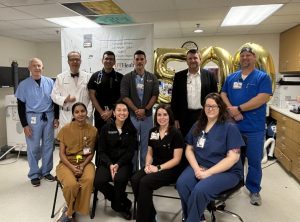 Tyler, Texas (October 21, 2024) — October is Healthy Lung Month so it seems especially fitting to share that UT Health East Texas recently celebrated a meaningful milestone of 500 patient lives impacted by Ion endoluminal system, which makes it easier for patients to know with certainty whether a suspicious lung nodule or lung mass is benign or cancerous. Lung biopsies performed with the Ion are less invasive and more precise.
Ion is the shape-sensing robotic-assisted bronchoscopy platform made by Intuitive, the pioneer in robotic-assisted surgery with da Vinci systems. This novel technology allows doctors to biopsy suspicious peripheral nodules and masses. This system can reach all 18 segments of the lungs to obtain a biopsy. The Ion system features an ultra-thin, ultra-maneuverable catheter and integrated vision probe that allows direct vision with navigation far into the peripheral lung, and with stability and precision needed for biopsy compared to traditional navigational techniques. Ion allows our pulmonary physicians to perform needle aspiration in a non-invasive procedure rather than having to puncture the chest wall.
About UT Health East Texas
UT Health East Texas provides care to thousands of patients each year through an extensive regional network that includes nine hospitals, more than 90 clinics, the Olympic Plaza Tower, 13 regional rehabilitation facilities, two freestanding emergency centers, regional home health services covering 41 counties, an EMS fleet of more than 60 ambulances and four helicopters, and a comprehensive seven-trauma center care network, including the region’s only Level 1 trauma facility.
As a partner with The University of Texas System, UT Health East Texas is uniquely positioned to provide patients with access to leading-edge research and clinical therapies while training and educating the next generation of physicians and other health professionals. The nationally recognized UT System also includes The University of Texas MD Anderson Cancer Center in Houston, The University of Texas Southwestern Medical Center in Dallas, as well as three other major university medical centers located throughout the state.