
Community Banker Michael W Marshall: Keeping your Accounts in Balance
Dollars and Sense – Michael W Marshall; Community Banker
Keeping your Accounts in Balance
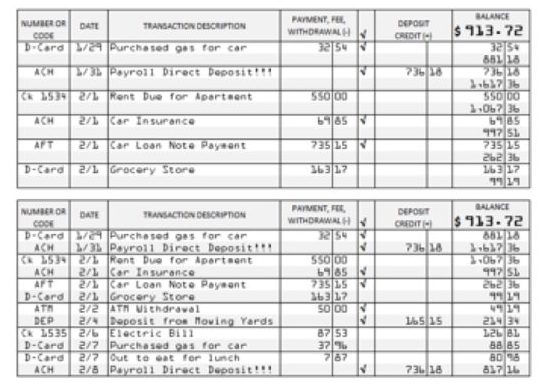
Balancing is simply tracking your income and expenses. Balancing your finances will help you determine how much, or how little money you have available to you. Check with your bank and they should give you a Check Register that looks like the below examples. The register will fit inside your checkbook.
Now I know what you are thinking…check register and a checkbook? But hear me out. Even though there are some great online tools that assist in balancing someone’s bank account, there is a huge benefit by you to old-school writing it out and doing math in a check register. By you physically putting all charges that you make in one place, this might even help you reduce spending money. Somehow, if you physically write it out in your own handwriting, it becomes more real and more meaningful to you.
Anything that costs you money will be a ‘Payment, Fee, Withdrawal (-)’ and anything that gives you money in the account would be a ‘Deposit Credit (+)’.
Be sure you write down transactions as they occur and put a check-mark √ only when you see the item posting either on your statement or through an online/phone monitoring system.
Codes can help you also; such as ‘D-Card’ = debit card transaction, ‘ACH’ – Automated Clearing House transaction, ‘Ck’ – Paper Check, ‘AFT’ – Auto Funds Transfer. You can also code things as they show up on your budget. By doing this, you can easily total up what is spent during the month and find out if and what category you overspent from your budget.
So you wanted that extra-large fountain drink on your way into work. You went out and got some fast food for lunch. You stopped by the grocery store to get a couple of treats for your family, then you had to stop by the ATM because your youngest needed some cash for a field trip. Finally on your way home you had to stop and get some fuel. Any of those purchases by themselves isn’t too bad; but if you write it up and look at it all written out, those 5 purchases probably totaled over $100.
Again, I am not judging you for what you spend your money on. I’m simply asking that you write it all down for a while so that you can see what all your money is being spent on. Now for some extra fun and excitement, let your significant other (or a close friend) look at what all you spend in a day, week, or month. Let’s just say that by having someone look at your purchases, you are able to scale back by $20 less each week on average. Did you realize that is over $1,000 per year! I don’t know about you, but I could sure use an extra $1,000 per year!
Once you have a good handle on balancing by hand with paper and pen; further investigate your local bank’s online banking platform. Most online banking platforms allow you to categorize your purchases as they clear your account. This will then show you graphically how your money is being spent. Some of the more robust online banking platforms will also allow you to set up budgets to help you stay on track. Financial Institutions refer to these type of tools as Personal Financial Management Tools.
As always if you are in a joint financial relationship, say with a spouse, it is very important that you and your spouse go through this together. It is so much easier navigating through finances with someone that is as dependent on your success as you are.
Keep in mind that good balancing leads to better budgeting which leads to more savings.
Michael W Marshall
Proud Community Banker