
An Hinojosa win would be a political feat, but she wouldn’t inherit the power Abbott holds
By Paul Cobler, The Texas Tribune
October 30, 2026
The Texas governorship was long considered a weak position until Republican Gov. Greg Abbott and his predecessor Rick Perry each spent long tenures amassing the kind of political sway needed to deftly achieve their agendas.
If Democratic state Rep. Gina Hinojosa manages to stop Abbott from securing a fourth term Tuesday, she’d be pulling off a consequential political victory. But she wouldn’t inherit the same level of power.
Abbott’s ability to manage state agencies is not due simply to statutory authority. His time in office allowed him to staff the agencies with Republican leaders aligned with his thinking, said Jim Henson, director of the Texas Politics Project at the University of Texas at Austin.
Abbott has “historic levels of influence because of the combination of his tenure, the nature of his appointments, and his maneuverability,” Henson said.
Hinojosa would also likely face something Abbott’s never had to: leading an executive branch in a divided state government. While Democrats could also pick up some seats in the Texas House on Tuesday, Republicans are expected to still hold that chamber and the state Senate next year.
“Certainly, the governor always has a legislative agenda, but that agenda only comes to reality when members of the House and Senate introduce the legislation and actually pass it,” said Sherri Greenberg, assistant dean at the LBJ School of Public Affairs at the University of Texas at Austin.
The last time the governor’s office and both chambers of the Legislature were controlled by opposing parties was 1995. That’s the year when George W. Bush first moved into the Governor’s Mansion after unseating Democrat Ann Richards, Abbott was appointed to the Texas Supreme Court and O.J. Simpson’s trial played out on American analog television screens.
But with Hinojosa, now a five-term Democratic legislator, either leading or narrowly trailing Abbott in recent public polling, the possibility of a divided state government is stronger now than it has been in decades.
“If you have a Democratic governor who is, essentially, a lone ranger in Republican state government, the incentives for cooperation among Republicans is not going to be very high,” Henson said.
If Democratic state Rep. Vikki Goodwin also ousts Republican Lt. Gov. Dan Patrick, that would give Hinojosa an ally overseeing the Texas Senate. But that chamber is all but certain to stay under GOP control next year. And much of the lieutenant governor’s powers are granted by a majority vote of senators each session, raising the prospect that Republicans could redraw the Senate rules to claim the office’s authority for themselves.
Control of the Legislature and executive branch by opposing parties was contentious in the past, Henson said, leading to many special legislative sessions — lawmakers’ version of overtime — as the two parties struggled to compromise on priorities.
When William Clements, a Republican, served two non-consecutive terms as governor in the 1970s and 1980s, Democrats dominated both chambers at the Capitol. Clements called 12 special sessions while in office, the second most of any governor and trailing only Perry,who called 13 during his three full terms.
Hinojosa has said her early priorities as governor would include a moratorium on new data centers, giving Texans a $1,500 check from the state’s savings, increasing teacher pay, replacing education commissioner Mike Morath and ending the state’s private school voucher program.
Hinojosa has laid out plans to use executive orders to shape state policy immediately upon taking office.
“Within an hour of taking the oath of office, I will declare a high-cost emergency in the state of Texas and issue an emergency executive order to: one, suspend the gas and diesel tax; and two, freeze electricity rates,” Hinojosa wrote in a statement.
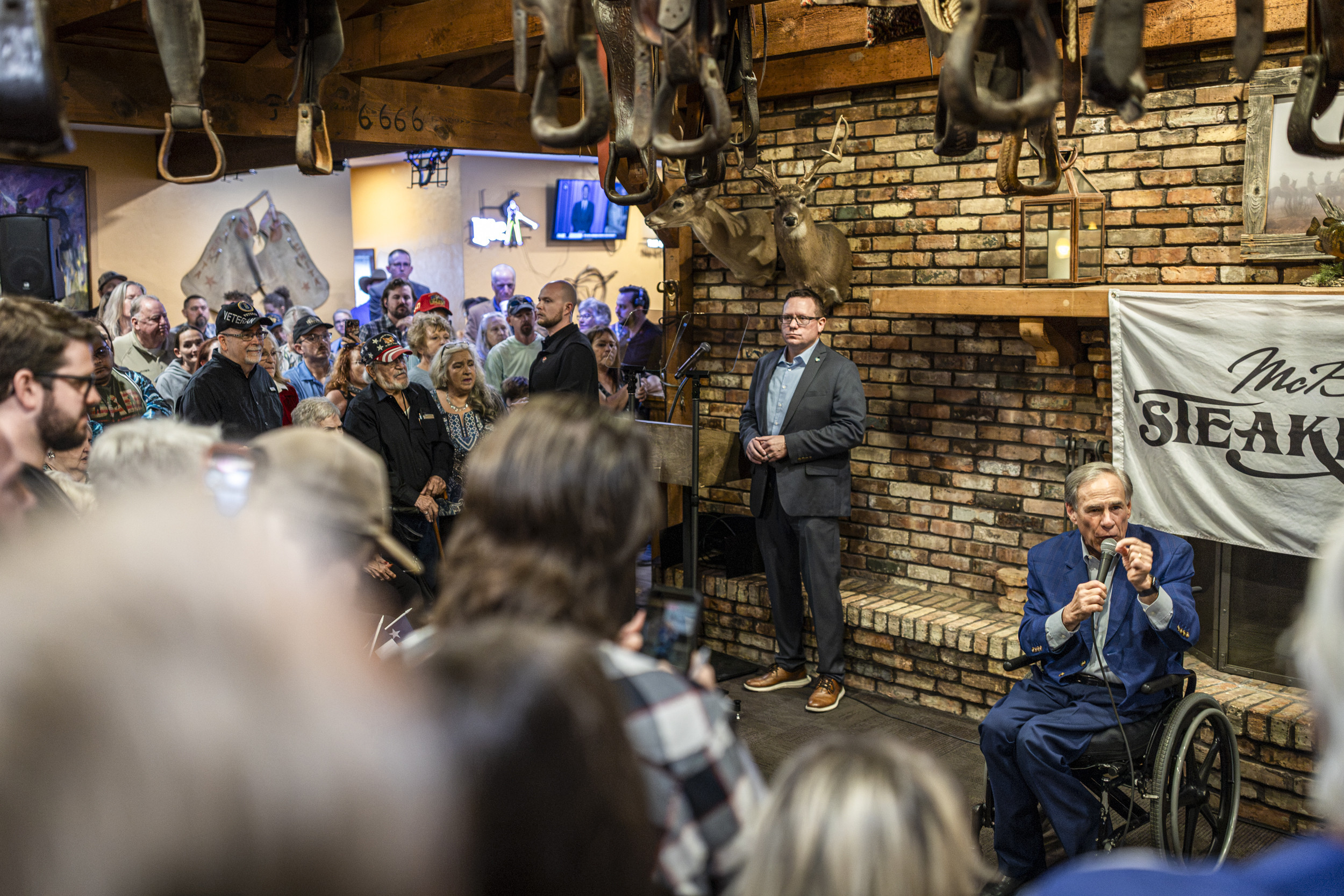
Abbott, whose campaign did not respond to a request to comment, has framed his reelection as an opportunity to continue his policies, which he credits with the state’s economic successes. He argues a Hinojosa victory would undo that work.
“What we have in Texas is precious, but it can all be destroyed in one election,” Abbott said at a campaign stop in Abilene on Monday. “We will not let the radical left crush our economy, destroy jobs, and increase taxes. Republicans must turn out to defend our values and keep Texas, Texas.”
Executive authority
Governors have the authority to direct state agency action through executive orders and declare emergencies through proclamation or executive order.
During COVID, for example, Abbott required masks be worn in public and later barred local governments and businesses from imposing mask mandates. He also directed state law enforcement to police the border with Mexico under a disaster declaration issued during President Joe Biden’s term.
Abbott in September directed the Texas Commission on Environmental Quality to pause the approval of all permits by data centers amid political backlash over their construction across the state. After facing criticism earlier this month that some permits were still being approved, the agency shut down its filing system entirely.
“The governor is using these agencies in a much more political fashion than before,” Rottinghaus said. “It’s surprising it took as long as it did to get there. That’s why for a long time people said governors are weak, and it’s because they didn’t really hammer down all the policies they could have, and so now we’re seeing them do that.”
Abbott in September issued a statewide disaster declaration over high fuel prices. The move allowed him to temporarily suspend restrictions on the use of red-dyed diesel fuel on Texas roads along with other restrictions on commercial transportation to lower fuel costs.
Disaster declarations last 30 days but can be extended indefinitely by the governor. However, they lack the permanency of a state law because any future governor can rescind past executive orders.
“By the end of the first day, her hand is going to be cramped signing her name to all these executive orders and agency rules,” predicted Brandon Rottinghaus, a professor of political science at the University of Houston. “So a lot of this is going to be rescinding what Abbott has done, and those are pretty straightforward.”
The primary check on executive power is the judicial branch, which has the ability to declare executive actions unconstitutional. Courts in Texas have largely agreed that the state Constitution grants the governorship the ability to manage the executive branch, Rottinghaus added, making it unlikely that executive power is checked under a Democratic or Republican administration.
Appointments
On the campaign trail, Hinojosa has vowed to fire Mike Morath, the Texas Education Agency commissioner, on “day one” of her term as governor.
But it may not be that simple because the terms of political appointees are staggered and run varying length of times. To remove one requires the “advice and consent” of the Texas Senate, according to the state constitution. If that can’t be achieved, a governor may need to wait out the appointees’ term before they can name a replacement.
In the case of Morath, the TEA commissioner serves four-year terms, and his term is set to expire in January. That means Hinojosa would be able to quickly name a successor should she win.
Whoever that nominated successor is, the Texas Senate is required to approve of the appointment by a two-thirds vote, according to the constitution. That means bipartisan approval will almost certainly be required.
Hinojosa has said she intends to build a “postpartisan” administration as governor, likely a necessity if her appointees require approval by a Republican-controlled Senate.
A governor can ask agency heads appointed by predecessors to resign, but they do not have to, Rottinghaus said. The longer a governor is in office, the more time they have to staff the executive branch with their appointees as holdovers from previous administrations finish their terms.
“The biggest power that governors in Texas have is longevity,” said Brandon Rottinghaus. “You can include the veto and appointments on that list, but it’s really about the length of time in office to put your stamp on Texas government.”
Legislative relationships
One of the most powerful abilities a governor has is a near-unstoppable veto.
This allows the state’s top elected leader to reject legislation approved by the House and the Senate. A veto can only be overridden by a two-thirds majority vote in both chambers.
Lawmakers can override vetoes only during the session in which the bills are rejected, according to policy experts. But typically, governors veto bills after the last day of legislative sessions.
The last time the Legislature overrode a veto was in 1979, when Clements was governor.
Perry holds the record for the most vetoes at 301. He issued a record 83 vetoes during a single legislative session in 2001, the last time Texas saw divided government.
Abbott has vetoed 280 bills throughout his three terms in office.
The intricacies of the process means that relationships among legislators and with the executive branch matter, whether or not control of government is divided, Greenberg added.
“In both cases, you really have to work the process to ensure there’s not going to be a veto of any of your bills that are seen as controversial whether the governor is a Democrat or a Republican because that is certainly a powerful tool that the governor has,” Greenberg said.
Greenberg experienced divided government as a legislator beginning in 1995 until she left office in 2001. She recalled carrying several bills for George W. Bush during his time as governor and having a good relationship with his office. That period was also marked by bipartisan successes, such as deregulation of the state’s energy grid, water infrastructure funding and telecommunication reform, she said.
The political incentives for both parties will be key to how successful any session is, Henson said. If either party believes it is in their best interest to be a roadblock until the next election, little is likely to move through the Legislature, he said.
Hennson said unless something changes significantly in the political landscape, he does not expect Democrats and Republicans to seek out many opportunities for bipartisan compromise.
“I don’t think that’s impossible, but it’s hard to see it happening very frequently,” Henson said.
Greenberg, who studies the ethical use of artificial intelligence, said the campaign may have revealed some opportunities for bipartisan cooperation around the issues of AI, data centers and affordability. When constituents want changes, opposing parties are far more likely to compromise, she added.
“When you have a situation where they may not get along personality wise, there’s lot of vitriol and/or they’re far apart on the political spectrum, then even more so it matters that their constituents — Democrats, Republicans, independents, whomever — are demanding actions on these issues,” Greenberg said.
Disclosure: The University of Texas at Austin has been a major financial supporter of The Texas Tribune. University of Houston and Sherri Greenberg have been financial supporters within the past five years. The Texas Tribune is a nonprofit, nonpartisan news organization that is funded in part by donations from members, foundations and corporate sponsors. Financial supporters play no role in our journalism. Find a complete list of them and more information about our financial and disclosure policies here.
This article first appeared on The Texas Tribune. 