
UT Health East Texas Orthopedic Surgeon Celebrates Milestone 2,000th Robotic-Assisted Joint Replacement Surgery
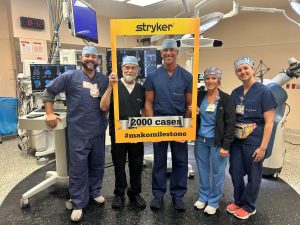 Tyler, Texas (August 27, 2026) — UT Health East Texas Orthopedic & Sports Medicine Institute is proud to recognize Dr. Joseph Conflitti, orthopedic surgeon and joint replacement specialist, for recently completing his 2,000th robotic-assisted joint replacement surgery, a milestone that reflects years of innovation, surgical expertise and a commitment to helping patients return to active, pain-free lives.
Dr. Conflitti began performing robotic-assisted procedures in 2016 following the acquisition of the Mako robotic system. He initially utilized the technology for partial knee replacements and expanded its use to total hip replacements in 2017 and total knee replacements in 2018. Since then, he has become one of the region’s most experienced robotic joint replacement surgeons.
“This milestone represents far more than a number,” said Dr. Conflitti. “It represents thousands of patients who trusted us with their care and who are now enjoying improved mobility, reduced pain and a better quality of life.”
A pioneer in advanced hip replacement techniques, Dr. Conflitti has performed the anterior approach to total hip replacement since 2007. This muscle-sparing procedure is performed through the front of the hip, avoiding the need to cut major muscles. As a result, patients often experience less pain, faster recovery, fewer activity restrictions and a lower risk of dislocation compared to traditional approaches.
Since 2017, Dr. Conflitti has combined the anterior approach with robotic-assisted technology, allowing for highly personalized surgical planning. Prior to surgery, patients undergo a CT scan that creates a detailed three-dimensional model of their anatomy. Using the robotic platform, Dr. Conflitti is able to precisely plan and position both the acetabular cup and femoral stem implants to optimize alignment, stability and function.
To date, he has performed more than 600 robotic-assisted total hip replacements. According to Dr. Conflitti, this individualized approach has contributed to an exceptionally low hip dislocation rate of approximately 0.16%, significantly below rates commonly reported in medical literature.
What further distinguishes Dr. Conflitti’s approach is his comprehensive utilization of robotic technology. While many surgeons use robotic systems primarily to assist with positioning the acetabular cup during hip replacement surgery, Dr. Conflitti incorporates data to optimize placement of both the cup and femoral stem, creating a customized reconstruction based on each patient’s unique anatomy.
In addition to his expertise in hip replacement, Dr. Conflitti has built a reputation for successful robotic-assisted knee replacement surgery. His patients typically begin physical therapy within hours of surgery, return home the same day and start a structured rehabilitation program immediately, helping promote a quicker return to daily activities.
“Robotic-assisted surgery allows us to improve precision and personalize treatment, but experience remains critical,” said Dr. Conflitti. “Technology is a tool. The ultimate goal is achieving the best possible outcome for each patient.”
About UT Health East Texas
UT Health East Texas provides care to thousands of patients each year through an extensive regional network that includes nine hospitals, more than 90 clinics, the Olympic Plaza Tower, 13 regional rehabilitation facilities, two freestanding emergency centers, regional home health services, an EMS fleet of more than 65 ambulances and four helicopters, and a comprehensive eight-trauma center care network, including the region’s only Level 1 trauma facility.
As a partner with The University of Texas System, UT Health East Texas is uniquely positioned to provide patients with access to leading-edge research and clinical therapies while training and educating the next generation of physicians and other health professionals. The nationally recognized UT System also includes The University of Texas MD Anderson Cancer Center in Houston, The University of Texas Southwestern Medical Center in Dallas, as well as three other major university medical centers located throughout the state.