
“ICE is everywhere”: In Houston, fear and grief permeate Latino neighborhoods after fatal shooting
By Alejandro Santos Cid, The Texas Tribune
July 15, 2026
Editor’s note: This story contains profanity.
HOUSTON — Not long after 7 a.m. on July 7, Buddy the dog howled.
“He has a different bark for everything,” said Clara, who was born almost 55 years ago in Tamaulipas, Mexico, jumped the border into Texas 26 years ago, and has been living in this corner of Magnolia Park, a neighborhood in east Houston, ever since. “But whenever he howls, it’s because he hears the ambulance.”
Clara and her family had grown used to sirens echoing through their neighborhood, so they didn’t think much of it. She kept working around the house — cleaning, cooking, getting the day going.
As the morning went on, the noise outside increased. Clara, who asked to be identified only by her first name because she is undocumented, began to hear movement on the streets, helicopters flying over them.
The bad news didn’t take long to arrive. A friend called her husband, Juan, and told him a Mexican worker had just been killed. The ambulance Buddy howled at was heading toward 6812 Canal St., barely two minutes from her home, to aid Lorenzo Salgado Araujo, a 55-year-old man who had just been shot by an Immigration and Customs Enforcement agent as ICE tried to stop the van he was driving after he picked up fellow construction workers to start their shift.
Salgado Araujo, a father of three who had lived and worked in Houston for 35 years, died in a nearby hospital. It was the first of two fatal ICE shootings within a week — an agent killed a 26-year-old immigrant from Colombia in Maine on Monday, also during a traffic stop.


On Tuesday, President Trump ordered ICE officers to halt most vehicle stops, The New York Times reported. That order came just hours after a tractor-trailer struck and killed a 28-year-old man who tried to run from ICE agents at a gas station in St. Augustine, Fla.
“This changes nothing. The raids will continue,” said 44-year-old community organizer Jessica Campos. “Families will still be terrorized in their homes, and people will still be targeted at their places of employment, putting even more people at risk of harm or even death. We are not safe anywhere.
“Vehicle stops were never the real problem,” she added. “The problem is the people behind the guns who keep killing our people, ICE.”
Trump’s mass deportation program has sent ICE agents into neighborhoods across Texas and the nation, hunting for undocumented immigrants. Agents first arrived in Magnolia Park months ago and started to arrest people. Neighbors went into hiding and warned each other about ICE sightings, suspicious unmarked vans parked near major intersections, friends being taken away.
Then, things seemed to calm down. People ventured back into the streets. Undocumented neighbors thought the worst had been left behind.
“But about a week ago, we started hearing again that they were back in the neighborhood,” Clara said.
ICE and the Department of Homeland Security haven’t released much information about Salgado Araujo’s shooting beyond an initial statement saying he rammed an ICE vehicle and was attempting to hit an agent with his vehicle when he was shot. A Department of Homeland Security spokesperson told The New York Times later that Salgado Araujo wasn’t the target — the agents were looking for two Guatemalan men.
On Friday, an attorney representing two of the men who accompanied Salgado Araujo in his van that morning said that they never tried to run over any ICE agents.
The Harris County District Attorney’s office has launched an investigation into Salgado Araujo’s shooting, after citizens and elected officials demanded an independent investigation.
After the shooting, Clara went looking in the Facebook groups that neighbors have been using for more than a year to alert each other about ICE raids on their streets. She saw smartphone videos of Salgado Araujo lying on the pavement, federal agents immobilizing him while he bled to death.
Like Clara and her husband Juan, Salgado Araujo jumped the border nearly four decades ago and built a life in Magnolia Park.
“It never crossed our minds that ICE would kill someone here in the neighborhood,” Clara said. “We knew they were taking people away, but not to the point of killing them. They’re becoming very violent. They don’t even care whether you’re a woman or that there are children with you.”
The day Salgado Araujo died, Juan had an evening job lined up not far from Canal Street, the first one after some time. Many of Juan’s colleagues decided to stay home that day, but Juan couldn’t afford it. The family needed the money.
The family decided Juan would go to work, but their youngest son Jose — a U.S. citizen who’s going to medical school on a scholarship — would tag along. That way, they thought, if ICE stopped them, there would be at least one person with an American passport in the car.
“I found myself wondering whether my dad was going to make it back home,” Jose said. “Since I have papers, if something happens to him, I can contact my mom or my sisters.”
Father and son headed out around the same time a crowd started to gather for a vigil on Canal Street.
Clara said they talk about returning to Mexico. Juan is getting tired of construction work. They stay, she said, for their children.
She said that she tries not to let fear rule their lives, but she’s been only going out to buy groceries and to church. Alerts about ICE sightings in the neighborhood keep coming to her phone.
“When my husband leaves for work, I put him in God’s hands, but I’m always worried about whether he’s going to come back,” she said. “ICE is everywhere.”

“They’ve silenced me”
In Magnolia Park, a predominantly Latino neighborhood in East Houston, many found ICE’s account of Salgado Araujo’s shooting too similar to the one the agency wielded after their agents fatally shot Renée Good, a 37-year-old mother and poet, during a January protest in Minneapolis against immigration enforcement operations in that city.
It also echoes ICE’s statements after an agent fatally shot 23-year-old Ruben Ray Martinez in South Padre Island last year while helping to direct traffic around an accident. ICE said Martinez tried to run over an officer, who opened fire in self-defense. When the body camera and security footage was released, the videos didn’t definitively corroborate the officers’ account.
“It’s obvious they used the same excuse as with Good — that Lorenzo had run him over. But, I mean, people are going to say that it’s obvious it’s the same story all over again,” said 38-year-old accountant Dulce Rivera, a Magnolia Park resident.
By Friday, rage and grief were boiling in East Houston. Residents with American citizenship or their papers in order gathered on Canal Street and improvised an altar to honor Salgado Araujo. They organized vigils, lit candles, mourned together and urged ICE to free the witnesses of Salgado Araujo’s shooting, among them his brother.
Meanwhile, undocumented neighbors went back to hiding, shut their blinds, and watched the protests unfold from their TVs and smartphones.
Silvina was driving around the city the day Salgado Araujo was shot, delivering food for DoorDash, a job she sometimes did to make ends meet. Whenever she needs to work for the delivery platform, she uses the account of her partner, who is a U.S. citizen.
“It scares me, but, well… we’ve got to eat,” said Silvina, who asked to be identified only by her first name because she’s undocumented.
That day, she noticed an unusual number of police officers out on the streets and immediately drove back home, where she saw a video of the shooting on social media.
“I completely freaked out. I haven’t gone back to doing DoorDash since that day,” she said.
Silvina said she worked as a photographer in her native Uruguay before her studio went out of business during the COVID pandemic and she decided to come to the U.S.


Silvina said she arrived on a tourist visa four years ago, along with her 10-year-old son and her then-partner, who had a green card. She waited tables, cleaned churches, and did some freelance photography to get by, and left that partner when he became abusive, she said.
She later met her current partner and they moved in together. “The idea is to get married and get my papers through him,” she said.
When ICE started raiding Houston, not long after Donald Trump was sworn in as president again, Silvina said she left a restaurant job out of fear.
“I was afraid to leave my house by myself. I always went out with my partner, and I still do to this day. Whenever I see a police officer, even though I’m not doing anything wrong, I just freeze up,” Silvina said. “After a while, I pulled myself together and said, ‘I can’t live like this.’ But I’m still careful. I either go out with my partner or with my friends, with a group of people.”
During the first protest against ICE in Houston, she stayed home. “It was the first time in my life I didn’t go to a protest I wanted to be at,” she said. She watched the rally from her window, waved her Uruguayan flag and cried.
“I became deeply depressed because I’d always been an activist, and then all of a sudden I found myself too scared to go to a fucking protest,” she said. “They’ve silenced me.”
Silvina wants to go back to Uruguay, but stays here because she thinks her son, who is 14 and is doing well at school, has more opportunities in Houston.
She says at this point, deportation is the least bad thing that could happen to her.
“Now they can put you in a concentration camp. They can separate you from your child,” she said. “What if they send me to another country? What if they detain me for months and, I don’t know, kill me?”
A wake on Canal Street
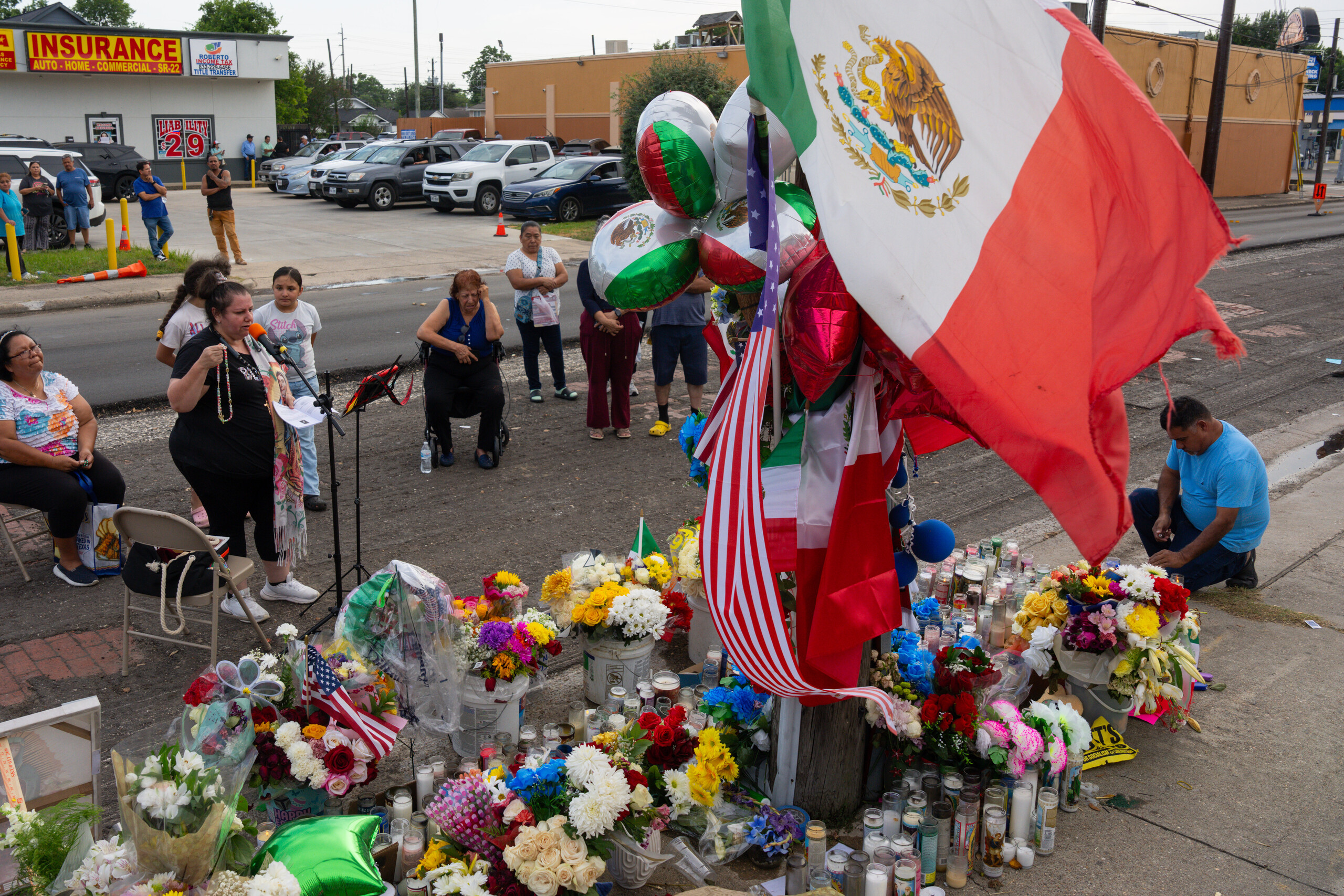
On Friday night at 6812 Canal St., the atmosphere was that of a wake.
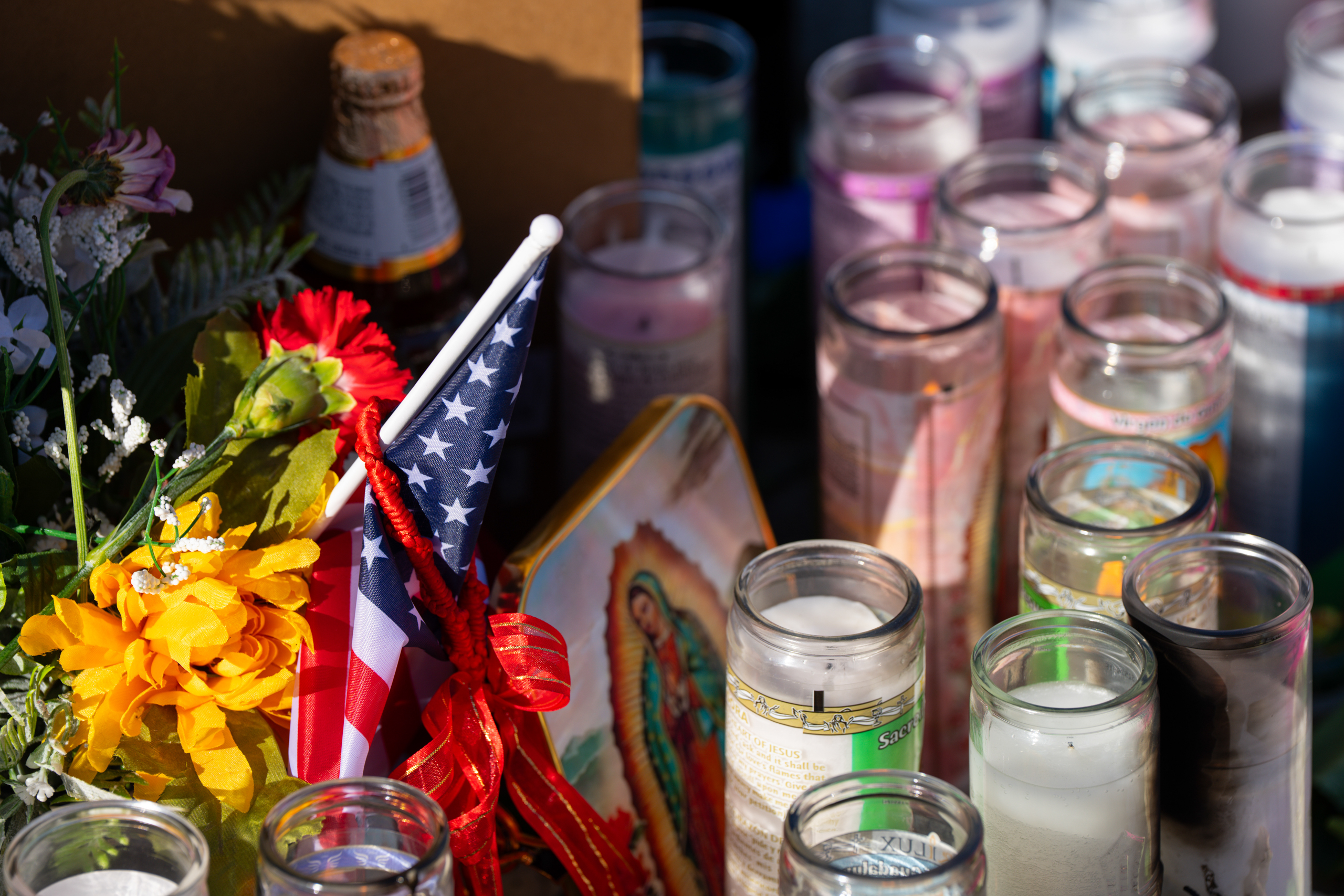
The altar to honor Salgado Araujo had grown in the days since the shooting. A crowd of twenty-something people surrounded it in silence, sobbing, fists clenched. A big Mexican flag waved above a smaller American one. Nearly everyone who arrived lit a candle and put it among the flowers, balloons, images of the Virgin of Guadalupe, signs calling to end ICE’s violence and demanding an independent investigation.
Another sign, in Spanish, read, “We come here to work, not to get killed.”
Campos, the community organizer, came with her daughter to pay their respects. They brought a bouquet of flowers.
Campos was born in Brownsville, the daughter of an U.S. citizen and a Mexican citizen, raised with the help of a stepfather from El Salvador. Now she mostly works with kids — many of them the children of undocumented parents.
“I was just having a conversation with a teacher who told me, ‘So-and-so stopped showing up, and I didn’t know why. Then they told me that the whole family was deported,” she said. “Every time I see a child cry because their family has been separated, I think about what that child will become, what they will do with that hate, the darkness they will carry inside.”
Campos said most families she knows in the neighborhood have been living in hiding for more than a year now — not only the undocumented ones, but all of the Latino population.
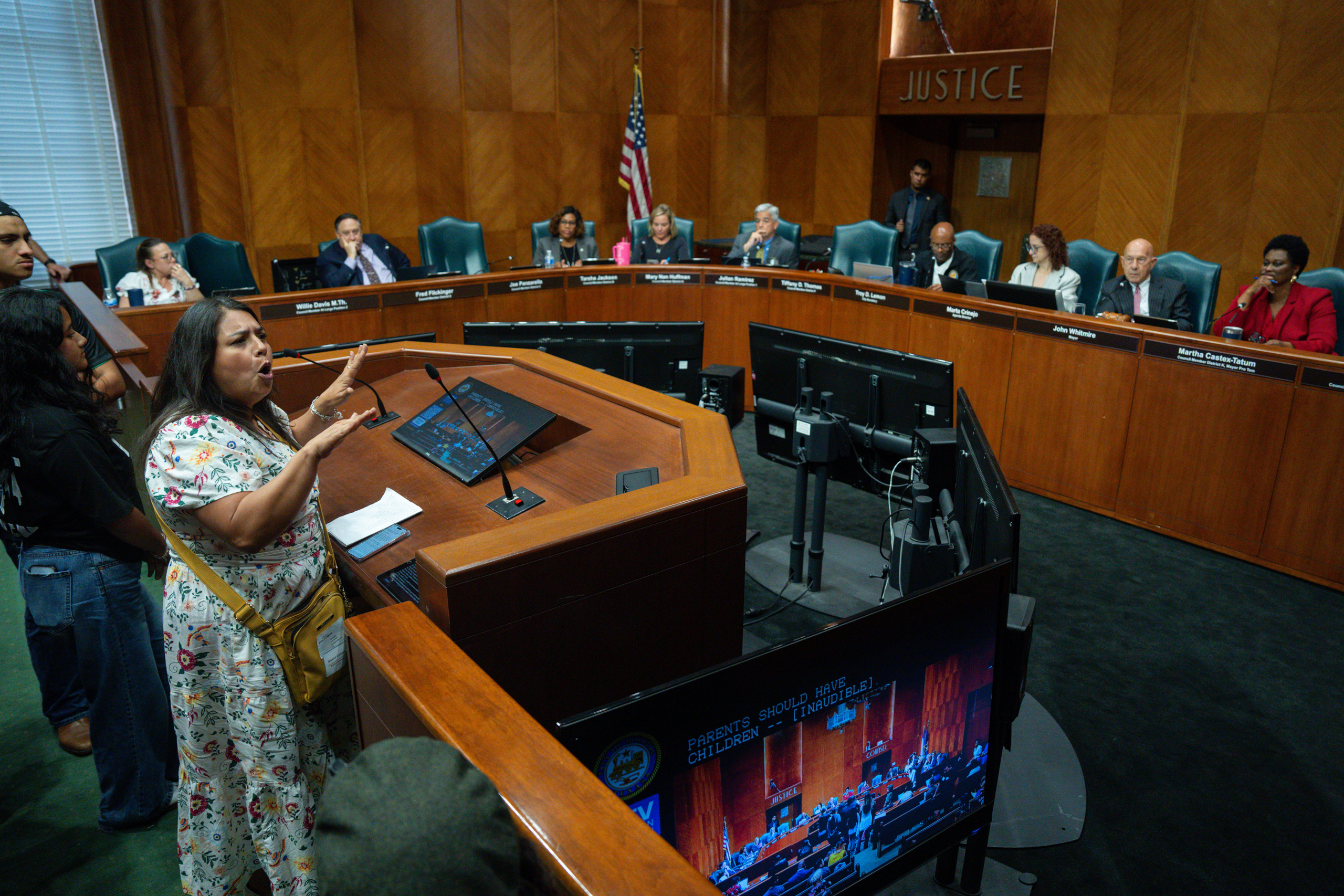

“Now it’s no longer just the fear of being deported; it’s the fear of being killed,” she said. “This is no way to live, waking up every day to another fight, another person killed, another person deported, another family separated, every single day.”
One day, when the raids were just beginning, Dulce Rivera took her son to the dentist. A woman and her daughter sat next to her in the waiting room.
Rivera noticed the woman’s leg was shaking.
The woman made a phone call. Rivera heard her saying that ICE was out in the parking lot. “What if they take me,” the woman asked the person on the other end of the phone. She couldn’t stop trembling.
Rivera, a 38-year-old accountant, was born and raised in Magnolia Park, the daughter of Mexican parents from Nayarit and San Luis Potosí who arrived in the U.S. decades ago, worked hard and got lucky enough, Rivera said, to get American citizenship.
Rivera lives seven minutes from where Salgado Araujo was shot to death. She said that her parents are the quiet types, never complaining out loud, just letting things be.
“But this time, when they killed Mr. Lorenzo, I told my mom, ‘Come with me to the protest.’ And she came, along with my daughter,” Rivera said.
It was her mom’s first protest.
“People are opening their eyes more and more,” Rivera said.
Francisco, who lives north of the city, came to Friday’s vigil to pay his respects. Like Salgado Araujo, he said he immigrated from Mexico to pursue the American Dream and also made a living working construction. Now in his 60s, he said when he got his American citizenship years ago, he felt a great joy.
Francisco, who declined to give his last name, said now he’s embarrassed to be a citizen. He’d rather tell people he’s from Mexico.
“I no longer feel that joy.”
Disclosure: DoorDash and The New York Times have been financial supporters of The Texas Tribune, a nonprofit, nonpartisan news organization that is funded in part by donations from members, foundations and corporate sponsors. Financial supporters play no role in The Texas Tribune’s journalism. Find a complete list of them here.
This article first appeared on The Texas Tribune.