Legacy of Texas is the official store of the Texas State Historical Association (TSHA).
Especially Texan is a weekly dive into historical topics that make up the tapestry of Texas history.
Especially Texan: Juneteenth
On June 19 (“Juneteenth”), 1865, Union general Gordon Granger arrived in Galveston and issued General Order Number 3, which read, “The people of Texas are informed that, in accordance with a proclamation from the Executive of the United States, all slaves are free.”
JUNETEENTH. On June 19 (“Juneteenth”), 1865, Union general Gordon Granger arrived in Galveston and issued General Order Number 3, which read, “The people of Texas are informed that, in accordance with a proclamation from the Executive of the United States, all slaves are free. This involves an absolute equality of personal rights and rights of property between former masters and slaves, and the connection heretofore existing between them becomes that between employer and hired labor. The freed are advised to remain at their present homes, and work for wages. They are informed that they will not be allowed to collect at military posts; and that they will not be supported in idleness either there or elsewhere.”
The tidings of freedom reached the approximately 250,000 slaves in Texas gradually as individual plantation owners informed their slaves over the months following the end of the war. The news elicited an array of personal celebrations, some of which have been described in The Slave Narratives of Texas (1974). The first broader celebrations of Juneteenth were used as political rallies and to teach freed African Americans about their voting rights. Within a short time, however, Juneteenth was marked by festivities throughout the state, some of which were organized by official Juneteenth committees.
The day has been celebrated through formal thanksgiving ceremonies at which the hymn “Lift Every Voice” furnished the opening. In addition, public entertainment, picnics, and family reunions have often featured dramatic readings, pageants, parades, barbecues, and ball games. Blues festivals have also shaped the Juneteenth remembrance.
In Limestone County, celebrants gather for a three-day reunion organized by the Nineteenth of June Organization. Some of the early emancipation festivities were relegated by city authorities to a town’s outskirts; in time, however, African American groups collected funds to purchase tracts of land for their celebrations, including Juneteenth. A common name for these sites was Emancipation Park.
In Houston, for instance, a deed for a ten-acre site was signed in 1872, and in Austin the Travis County Emancipation Celebration Association acquired land for its Emancipation Park in the early 1900s; the Juneteenth event was later moved to Rosewood Park. In Limestone County the Nineteenth of June Association acquired thirty acres, which has since been reduced to twenty acres by the rising of Lake Mexia.
Biracial Unions on Galveston’s Waterfront, 1865-1925
Particular celebrations of Juneteenth have had unique beginnings or aspects. In the state capital Juneteenth was first celebrated in 1867 under the direction of the Freedmen’s Bureau and became part of the calendar of public events by 1872.
TSHA Members get 10% OFF
every purchase!
TSHA Members get 10% off of
every purchase through the
Legacy of Texas store!
In addition, you will gain exclusive access to the TSHA Digital Library, with Southwestern Historical Quarterly, Texas Talks, and so much more! Enhance your exploration of Texas history with a TSHA Membership!
Juneteenth in Limestone County has gathered “thousands” to be with families and friends. At one time 30,000 African Americans gathered at Booker T. Washington Park, known more popularly as Comanche Crossing, for the event. One of the most important parts of the Limestone celebration is the recollection of family history, both under slavery and since. Another of the state’s memorable celebrations of Juneteenth occurred in Brenham, where large, racially-mixed crowds witness the annual promenade through town. In Beeville, residents of all races have also joined together to commemorate the day with barbecues, picnics, and other festivities.
The 1960s brought changes to the celebration. During the civil rights movement, student participants in Atlanta, Georgia, “wore Juneteenth Freedom buttons.” The 1968 Poor People’s March to Washington, D.C., ended on June 19, and partakers returned to their home cities across the nation, including Milwaukee and Minneapolis, to celebrate the event. These two cities still hold some of the largest Juneteenth events. The Black Power movement engendered “racial pride, economic empowerment, and the creation of political and cultural institutions,” and brought renewed focus on celebrating Juneteenth.
Representative Al Edwards, a Democrat from Houston, introduced a bill calling for Juneteenth to become a state holiday. The state legislature passed the act in 1979, and Governor William P. Clements, Jr., signed it into law. The first state-sponsored Juneteenth celebration took place in 1980. In succeeding years, Juneteenth also had an impact outside the state. African American Texans who moved to Louisiana and Oklahoma have taken the celebration with them. In 1991 the Anacostia Museum of the Smithsonian Institution sponsored “Juneteenth ’91, Freedom Revisited,” featuring public speeches, African American arts and crafts, and other cultural programs. There, as in Texas, the state of its origin, Juneteenth has provided the public the opportunity to recall the milestone in human rights the day represents for African Americans.
Father’s Day Book Sale!
Father’s Day is just around the corner, and we have a special treat for all the history-loving dads out there! TSHA is excited to announce our exclusive Father’s Day Sale, featuring incredible discounts on a wide range of our historical books. At checkout, enter the coupon code AUSTIN to apply the 25% discount.
Perhaps the most significant turning point in the contemporary recognition of Juneteenth occurred in 2020 in the wake of the death of former Houston resident George Floyd at the hands of Minneapolis police officers. That year, immeasurable Juneteenth observations also called for police reforms. University of Texas African American history professor Daina Ramey Berry, a guest for the New York Times Juneteenth podcast, noted, “When I think about Juneteenth as Emancipation Day, and I think about this moment, I feel like we still need to be emancipated.”
Join us for this Texas Talks presentation that promises to be an engaging and informative journey through the lesser-known aspects of Juneteenth. D. J. Norman-Cox, an expert historian and author, will delve into a wealth of obscure mid-19th-century documents, offering a factual yet entertaining presentation of Juneteenth’s history.
Take this chance to deepen your knowledge, dispel common myths, and celebrate the true history of this significant day.
Opal Lee, a ninety-three-year-old retired Fort Worth educator and civic leader, also saw the 2020 Juneteenth celebration as the opportunity to call greater attention to her more than forty-year quest to ensure that the day became a national holiday.
By late June 2020 her petition to achieve that goal had reached one million signatures. Moreover, in 2020 residents in all major regions in the state observed the event, but due to the coronavirus pandemic that limited public gatherings, celebrations were held through online communications platforms. Thus in 2020, at a critical juncture in the state’s and nation’s history, Juneteenth became a celebration of freedom steeped in the centuries-long struggle to end racism in America.
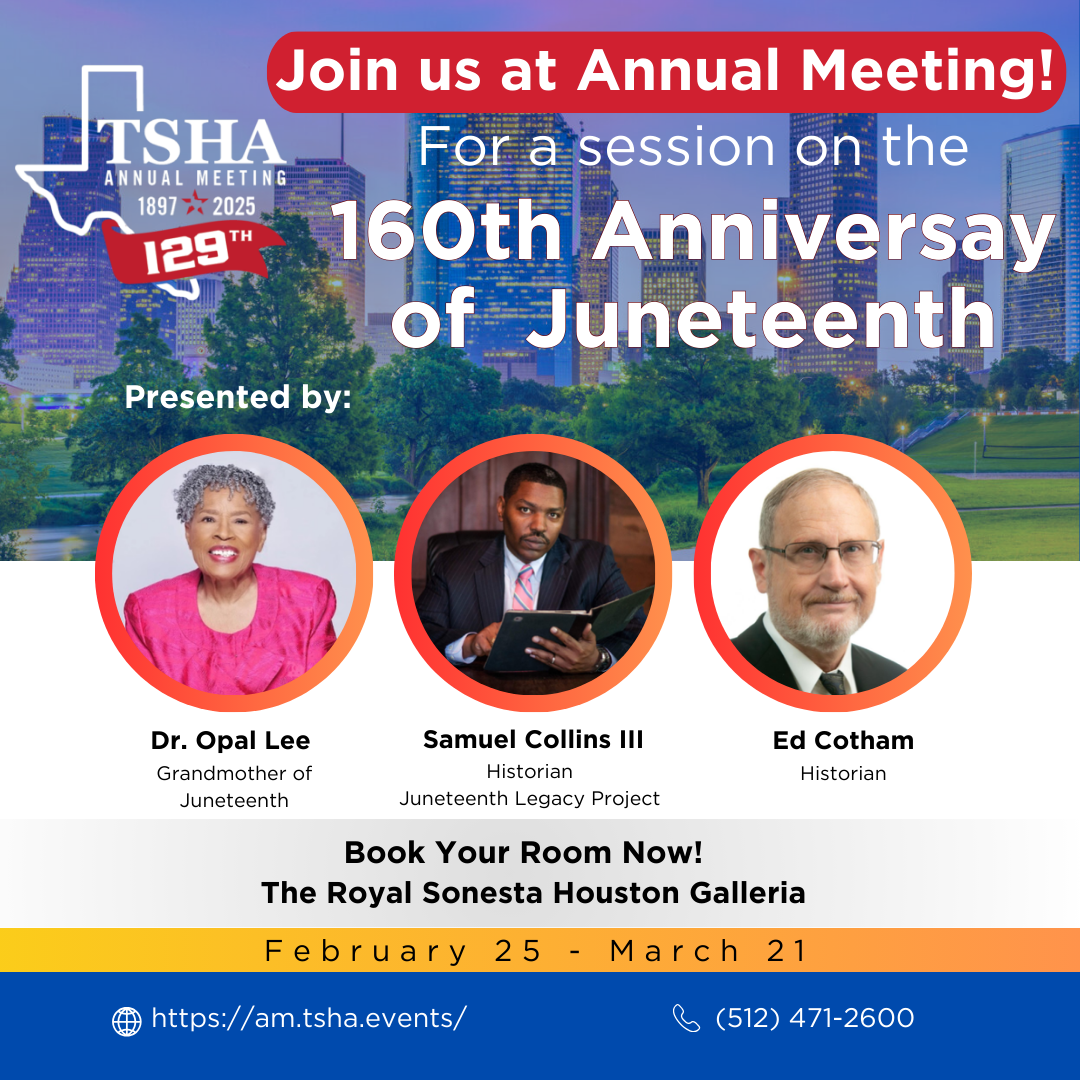
160th Anniversary of Juneteenth with Opel Lee
This new session features the esteemed “Grandmother of Juneteenth” Opal Lee, who will share her journey of resilience and activism crucial to making Juneteenth a federal holiday. Her reflections on community empowerment will inspire and educate. She will be joined by historians Samuel Collins III, a 7th generation Texan and advocate for truth in American history, and Ed Cotham, a scholar in Civil War preservation, who will provide unique insights into Juneteenth’s significance.
This is just one of the exciting new sessions we have scheduled for the TSHA 129th Annual Meeting in Houston from February 26 to March 1. Take advantage of TSHA hotel block and book your room now at The Royal Sonesta Houston Galleria.
The end of a long struggle to create a national holiday in recognition of Juneteenth finally arrived on June 17, 2021. On that day, President Joseph Biden signed into law a bill creating Juneteenth National Independence Day. Opal Lee of Dallas, the most famous proponent of the holiday, was present at the signing. This momentous event arrived nearly 156 years to the date that General Order Number 3 was delivered in Galveston. The long-awaited federal recognition of Juneteenth was greeted in Galveston similarly to the event of June 19, 1865, as a joyful and important occasion. The city’s 2021 celebration included the dedication of the Absolute Equality mural by Houston-based artist Reginald C. Adams. The mural’s title is drawn directly from the language of General Order Number 3. The reading of the Emancipation Proclamation at Ashton Villa, the Emancipation March, and the Juneteenth Festival featuring music, food, and fireworks were part of the triumphant celebration.
Our Mission: To foster the appreciation, understanding, and teaching of the rich and unique history of Texas and, by example and through programs and activities, encourage and promote research, preservation, and publication of historical material affecting the state of Texas.