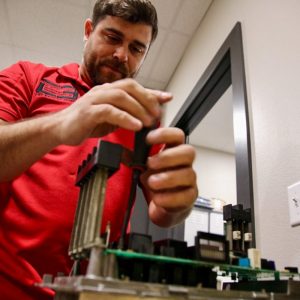
DPS Honors Crime Laboratory During National Forensic Science Week

AUSTIN – During National Forensic Science Week, the Texas Department of Public Safety (DPS) is proud to recognize the hardworking men and women of the Crime Laboratory Division.
“Texas is a leader in forensic science because of the incredible men and women working in DPS Crime Laboratories across the state every single day to help solve crimes and bring justice to victims,” said DPS Crime Laboratory Division Chief Brady Mills. “This National Forensic Science Week, we celebrate the achievements they’ve made and their continued efforts to serve the people of this state.”
Some of the major achievements of the last year include:
- DPS’ Crime Laboratory Division processed 113,259 requests for forensic testing and uploaded a record 148,993 arrestee and offender DNA samples to the Combined DNA Index System (CODIS).
- The department’s Breath Alcohol Program hosted 64 breath test operator schools and certified approximately 1200 new breath test operators in the last year.
- The Sexual Assault Evidence (SAE) Tracking program, which allows survivors to anonymously monitor the status and location of evidence, concluded its seventh year of statewide electronic tracking on Aug. 31, 2026. To date, 72,549 sexual assault kits (SAKs) are being tracked in Track-Kit, with 10,603 kits collected statewide in 2026.
- DPS continues testing older SAKs that have previously never been submitted to a crime laboratory and had been stored, untested in property rooms across the state. DPS has completed an additional 725 SAKs as part of this project just this year thanks to supplemental grant funding from the Office of the Governor.
- DPS has initiated the launch of its statewide initiative called Texas CLR Connect as directed under SB 991, which passed during the 88th Legislative Session. This software portal is designed to streamline the request and transfer of crime laboratory records among crime laboratories, attorneys representing the state and other authorized parties as part of the criminal discovery process under Article 39.14, Code of Criminal Procedure.
- DPS’ Crime Laboratory Division completed the first phase of SB 1723 – a new law passed by the 89th Legislature to explore the use of Rapid DNA technology at booking facilities in Texas. Using Rapid DNA technology, booking facilities would be able to enter an arrestee’s DNA sample and test it against the CODIS database in under two hours, which could prevent violent offenders from being released back into the community. At this time, all felony offender samples must be sent to DPS’ CODIS lab in Austin for processing. The Williamson Co. Sheriff’s Office (WCSO) and Montgomery Co. Sheriff’s Office (MCSO) are participating in the pilot program, which began on Sept. 1, 2025. Over the last year, DPS has worked with the WCSO and MCSO on instrument installation, technology integration and training. Heading into the second year of the pilot program, participants will begin entering arrestee samples into the Rapid DNA system. DPS will report findings from the second year of the program back to the Texas Legislature no later than Jan. 1, 2028, for consideration in determining additional funding or expansion of the program.
- On Dec. 1, 2025, DPS’ Crime Laboratory Division implemented the state’s new Limited Consent for DNA Testing Program for sexual assault survivors. Created under HB 1422, the Limited Consent for DNA Testing Program allows survivors of sexual assault to obtain a forensic medical exam and have evidence collected and tested for foreign DNA material, free of charge, even if a report has not been made to law enforcement. To date, over 500 kits have been submitted to DPS under this program.
About DPS’ Crime Laboratory Division
Established in 1937, the Crime Laboratory Division started as a one-chemist operation located at Camp Mabry in Austin. Almost 90 years later, the Crime Laboratory Division has developed into a comprehensive forensic laboratory system with 16 accredited labs and programs spanning the state and approximately 712 personnel.
DPS Crime Laboratory Division’s standard areas of analysis include:
- Trace evidence (i.e., hair, fibers, paint, glass, gunshot primer residue, impressions, ignitable liquid residue)
- Biology/DNA
- Digital/multimedia evidence
- Firearms and toolmarks
- Friction ridge analysis
- Forensic documents
- Seized drugs
- Toxicology
These services are provided at labs statewide, strategically located for optimal access. The support of investigative capabilities is further enhanced by the integration and exchange of local, state, regional and national information via individualizing databases, including the Automated Fingerprint Identification System (AFIS) and CODIS.
The Crime Laboratory also includes the Breath Alcohol Laboratory (BAL) and its Office of the Scientific Director (OSD). The BAL and OSD are legislatively charged with administering a statewide judicially acceptable forensic breath alcohol test program for the Crime Laboratory and for programs operating outside of the DPS Crime Laboratory System.
As part of National Forensic Science Week, DPS is offering public tours at some crime laboratories across the state. All are free of charge.
View photos from the DPS Crime Laboratory here.