
Can Austin break the costly cycle of homelessness, jail and crisis? A new program aims to do that.
By Austin Current, The Texas Tribune
August 17, 2026
On a hot August afternoon, Marcus Martin walked out of the Travis County Correctional Complex in Southeast Austin after about six months behind bars, a broad smile stretched across his face. He’s been incarcerated before, but he believes this time is different.
Outside the facility, several people awaited his release in their vehicles, blasting the air conditioning, while another went inside to greet Martin, made sure he had all of his belongings and walked him through what came next.
The team waiting for him were not social workers, case managers or family, but sworn Austin Police Department officers assigned to a new program called No Wrong Door, a cross-agency effort aimed at helping people experiencing homelessness with complex mental health disorders who have frequent interactions with law enforcement and public health systems.
“This right here is a beautiful blessing,” Martin said. APD Officer Edward Soltys “didn’t look down on me. He actually talked to me and made me feel like a human again, and not just an inconvenience.”
Martin is one of roughly 950 people local officials identify as the county’s highest “utilizers,” residents whose repeated arrests, emergency room visits, psychiatric crises and criminal trespasses cost an estimated $137 million in public resources each year while often leaving the underlying problems untreated.
Austin leaders believe No Wrong Door, could change that by coordinating police, hospitals, homeless service providers and other agencies around people who have proven hardest for existing systems to reach. The effort is a test of whether Austin can move beyond repeatedly responding to the same crises and instead help some of the city’s most vulnerable residents escape the cycle of jail, hospitals and the streets.
For Martin, a series of life events and a bad breakup led to him becoming homeless for several years. Drug use kept him there and away from his family.
“With me going down the rabbit hole I was going down, it wasn’t productive or beneficial for me to be around them,” he said. “I was being selfish, to be honest with you, and chose drugs over my own safety.”
That rabbit hole led to frequent interactions with local law enforcement and, eventually, a jail sentence. It also led to Martin being identified as a candidate for No Wrong Door while behind bars. Officers in the program met with him while he was incarcerated to determine what support he would need upon release to stay healthy and out of jail. For Martin, that meant checking in at an Integral Care clinic to continue receiving mental health treatment.
“I’m ready to grow,” he said. “I think it’s gonna be a beautiful thing.”
A different kind of policing
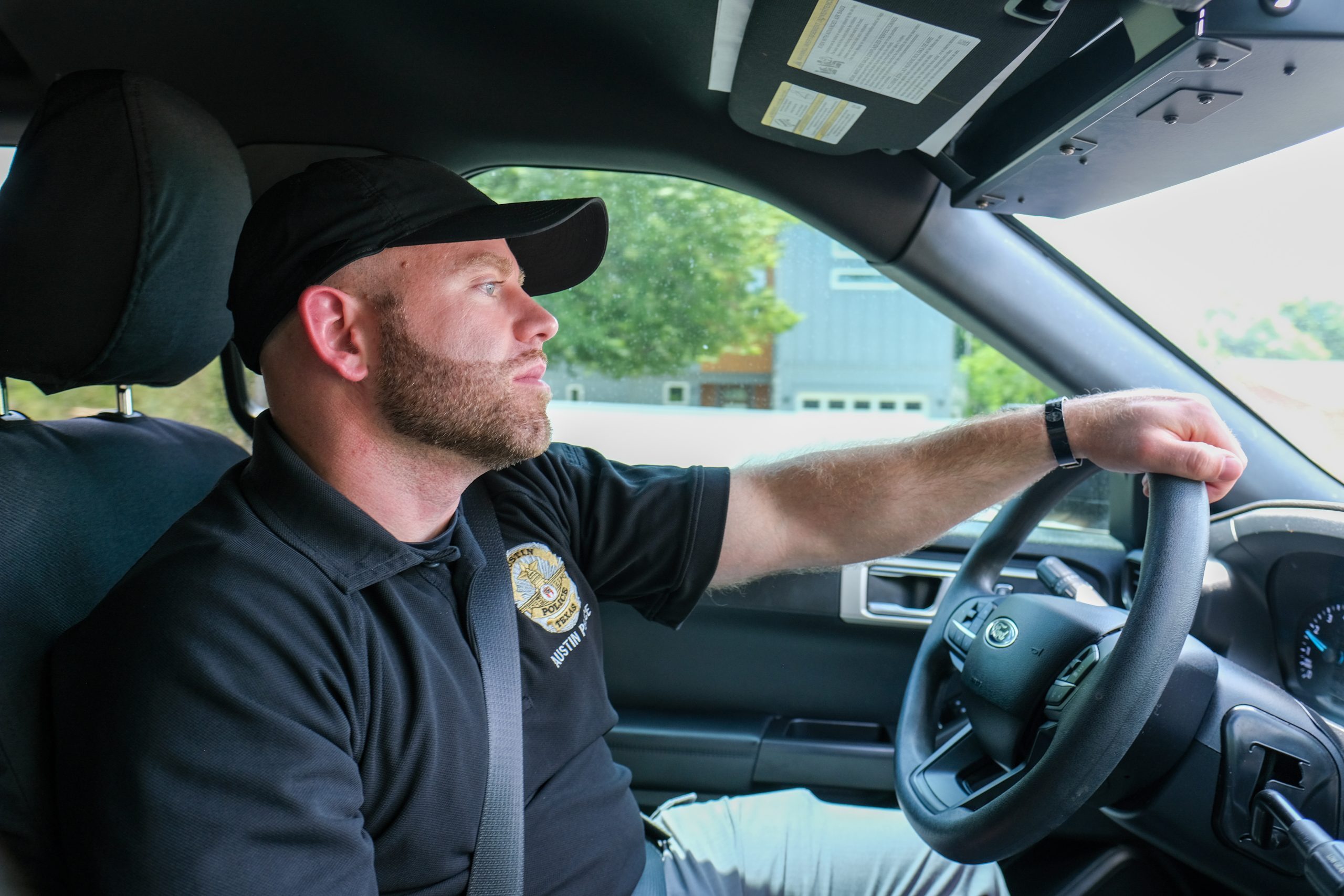
Repeated cycling through public systems without resolving the problems that brought them there is common among the people No Wrong Door is designed to reach, city officials say.
“The system isn’t built for them,” said Cody Martin, an APD officer assigned to the program. “These are complex individuals with complex needs that require hyper-focused attention and effort.”
Both he and Soltys are two of the four Austin police officers selected for the program based on their experience or interest in mental health calls, homeless outreach efforts and substance abuse.
Since early March, each officer has been assigned about 25 people who meet the program’s criteria. Their job is to meet clients where they are — on the streets, in rehabilitation facilities, at homeless shelters, in jails — and help coordinate treatment, housing and other services.
The officers said they’re working to build relationships with clients to better understand the root causes driving their repeated interactions with law enforcement and other public systems. APD’s work through this program is being funded through existing resources.
“Getting somebody housed or getting them the treatment that they need is a daunting task,” said Officer Steven Creamer, another one of the program’s officers. “I think they’re excited to have somebody in their corner cheering for them and trying to get them through the process.”
Officer Martin recently drove one of his clients, a military veteran, from the Travis County Jail to a VA hospital in Temple, about 75 miles north of Austin, after securing him a spot in a treatment program. Before No Wrong Door, Martin said the man was a familiar face with law enforcement.
“He was getting arrested every single week, and we have not had a police interaction with him in 119 days,” he said.
That kind of hands-on involvement is central to the program. It also raises a fundamental question about its approach: whether police officers should be the ones building those relationships.
Some advocates question whether law enforcement should be tasked with helping this population. At a time when police are involved in encampment sweeps and facing ongoing criticism for interactions with people experiencing homelessness, they question whether officers should serve as a primary point of contact for the people the program is trying to help.
“I think this sounds like some good intentions there, but I’m very worried about rights violations and making sure people still have agency,” said Cate Graziani, co-director of VOCAL-TX, a local homelessness advocacy group. “When a cop is asking you to do something, it’s not the same as when a social worker was talking to you about it.”
A collaborative approach
City officials note the four officers are only one piece of No Wrong Door. The broader effort is built around addressing another problem: agencies that encounter many of the same people have historically operated with little coordination.
Austin Legislative Director Carrie Rogers said when she began examining the city’s homelessness response, she found agencies and organizations serving the population were often operating in silos with little coordination, making it harder to connect people experiencing mental health crises with the care they needed.
“We’re trying to figure out where those gaps are,” Rogers said.
Rogers said all 17 partner organizations have entered agreements to share resources and information to identify the people cycling through systems and better connect them with care so they don’t end up back on the streets without proper treatment. If an Austin police officer or EMS responder comes into contact with someone identified through No Wrong Door, they may be able to alert one of the program’s dedicated APD officers, who can help coordinate a response rather than starting from scratch.
Representatives from the 17 partner organizations also meet regularly to discuss high-utilizer cases and coordinate care.
“I think the public expects our systems to coordinate and work. That’s not what we were doing before,” said David Gray, director of Austin Homeless Strategies and Operations. “No Wrong Door allows us to do that type of coordination to ultimately get people into the right type of long-term care.”
Gray said Austin’s comparatively robust behavioral health system has also made the city a destination for people with complex health needs from surrounding counties that have fewer resources.
He pointed to a recent case involving an elderly woman who, he said, arrived in Austin after being given the choice of a bus ticket to Austin, Houston or Dallas. She stepped off the bus without a wheelchair, medications, a phone or any support system, an example of what Gray described as outside jurisdictions “essentially dumping their challenges into cities like Austin.”
“No human should ever be treated this way,” Gray said in a recent social media post about the situation.
Gray said cases like that illustrate why city leaders believe coordination alone cannot solve the region’s behavioral health challenges. Austin continues to see rising homelessness while providers say the need for mental health treatment and supportive housing has outpaced available resources.
In 2025, volunteers and local providers counted more than 3,200 people living outside or in shelters, up about 50% from about 2,150 people in 2018, according to point-in-time data.
For Graziani, however, better coordination comes after years in which the government failed to make the investments that might have prevented some people from reaching this point.
“When those people were asking for help years ago, they weren’t doing anything to help them,” Graziani said. “There were so many things they could have done to help these people earlier.”
Graziani said that could have included greater investments a decade ago in expanding mental health care or creating more deeply affordable housing, defined as housing affordable to families earning 30% of the median family income or less.
“If somebody’s on a disability check, they can’t live anywhere in Austin, so they live on the street,” she said. “Living on the street is going to traumatize people.”
What comes next
No Wrong Door is still in its early months, but Austin police say they are beginning to see signs that the approach can reduce repeated encounters with officers.
The department analyzed how much time officers spent with a person experiencing chronic homelessness before and after the person entered the program. The number of patrol incidents, officers involved and hours spent responding to the person all decreased sharply since April, according to the department analysis, reducing costs and freeing officers to respond to other incidents.
“We’re getting some wins, but we’re going to need money,” Mayor Kirk Watson said. “We don’t have a system that is working, and we don’t have enough beds.”
That shortage is now shaping a legislative agenda the city plans to pursue next session, including advocating the state for funding to build a new mental health crisis care center, which could go on the same property as the Austin State Hospital.
Austin State Hospital remains at capacity, and city officials say many patients who no longer need inpatient psychiatric care have nowhere to go. Along with funding for a new mental health crisis center, the city plans to advocate for additional “step-down” beds where people can continue recovering after leaving the state hospital.
For city leaders,that is part of the larger test of No Wrong Door. The program can connect people with services and coordinate agencies that once worked independently, but breaking the cycle also depends on whether treatment, housing and other resources people need are available and ready for them.
For Marcus Martin, that test is now beginning.
“I’m ready to go forward,” Marcus Martin said. “I’m ready to progress.”
This article first appeared on The Texas Tribune.