
How two churches forged Jasmine Crockett and James Talarico’s politics
By Kayla Guo, The Texas Tribune
February 25, 2026
Before she joined St. Andrew’s Presbyterian Church, Laura Landsman was raised a Southern Baptist. She spent a summer as a missionary for the church and at one point served as a counselor for Billy Graham’s evangelical crusades.
The 74-year-old Weatherford native, as she tells it, was “devoted to fundamentalist Christianity.” Then her idea of what it means to be Christian started changing, and she found herself feeling lost.
That was several decades ago. On the third Sunday of this month, she sat with around a dozen congregants at a meet-the-ministers lunch at St. Andrew’s, discussing what brought her to the progressive church in North Austin that counts among its longtime members state Rep. James Talarico, a 36-year-old Democrat now running for U.S. Senate.
“We didn’t have to continue to pretend to believe what didn’t feel right,” Landsman said of joining St. Andrew’s, adding that the church “makes it clear that we’re all just one big family, no matter the culture or belief system.”
Another St. Andrew’s congregant of almost a decade, Martha Cole, echoed that she felt at home at a church that emphasizes “radical, universal love, and not all these dusty old creeds and dogma” — a religious ethos that also flows through Talarico’s political identity and his campaign for Senate.
More often the province of Republicans running for office, religion has played a striking role in Texas’ Democratic primary for U.S. Senate this election cycle, with Talarico — an aspiring Presbyterian minister whose interest in politics was kindled at St. Andrew’s — in particular expressing his faith and Jesus’ commandment to love thy neighbor as the foundation of his progressive political outlook. The Austin Democrat’s viral rise to stardom was powered by his use of Biblical reasoning to counter Christian nationalism and to advocate for liberal causes like abortion access and LGBTQ+ rights in debates with Republicans widely circulated online.
“In my faith, love is the strongest force in the universe,” Talarico said at a campaign rally in Austin last week. “A new kind of politics is possible. It’s waiting to be born through all of us, and a movement that radiates that kind of love is unstoppable. It will win — and we have a moral imperative to win.”

While Talarico has brought religion to secular campaign spaces through a populist, faith-based pitch, his chief primary opponent, U.S. Rep. Jasmine Crockett, has targeted the political power of the pews, working to supercharge Democratic turnout by tapping into the civic power of Black churches like her own. She has drawn hundreds to campaign events held at over a dozen Black churches around the state, while wielding endorsements from groups like the National Baptist Convention, USA, Inc.
Crockett, whose father is a pastor, said she sees her upbringing in Black Baptist churches as a “grounding” force, and the Black church as a historical organizing power for social justice causes and a critical part of the Democratic Party’s base.
“It’s going to be integral in the general election to have those relationships,” Crockett said, “to be able to go in, and people understand that you understand the real tradition of Black church and liberation that has been sought for decades, and the role that faith and social justice have played.”
Talking about faith, she thinks, is not so much what’s going to move the needle toward a blue Texas as her message that she will fight against Trump’s GOP on Texans’ behalf — a promise she believes will mobilize infrequent and devoted Democratic voters alike to carry her to a statewide win.
“We’ve seen these crazy swings that have been taking place, and they haven’t been taking place over faith,” she said, referring to recent Democratic wins in special elections. “The most important conversation that Democrats can really engage in is connecting the policy to the pain.”
To win statewide, Crockett, 44, is arguing she can harness Texas’ demographic changes and attract sky-high turnout of left-leaning Black, Latino and Asian voters. Black voters form the base of her support, with recent polling finding her winning upward of 71% of Black primary voters, largely because of the figure she cuts among the base as an unflinching Democratic speaker.

Talarico, meanwhile, has foregrounded religion in his politics and campaign message in a way few Democrats have tried in recent decades. The four-term lawmaker has wrapped his populist top-versus-bottom message in the language of faith with the hope that it will resonate with independent and right-leaning voters, some of whom will be necessary to win a state that President Donald Trump took by 14 percentage points.
In the cadence of a sermon and with a more-than-occasional mention of Scripture, Talarico has delivered his stump speech in red and blue areas across the state, betting that his religious foundation “opens a door” to that broader coalition of voters.
“There are a lot of people who feel that the Democratic Party, in recent years, has been hostile to people of faith,” Talarico said in an interview last year. Talking about faith, he added, “creates an opportunity for connection. I don’t think it automatically wins you over, but it starts a conversation.”
Around two-thirds of Texans identified as Christians in 2024, according to the Pew Research Center. The Democratic Party dominated among atheist, agnostic and religiously unaffiliated voters across the country, while Christian voters generally favored the GOP. That varied by race, with Black Protestants heavily favoring the left, Hispanic Catholics leaning Democratic and Hispanic Protestants divided.
Talarico’s progressive Christianity has already prompted backlash from those on the religious right, who see his faith as incongruous with their own, despite a shared vocabulary. White evangelicals make up around a quarter of Texas’ electorate and went almost 90% for Trump in 2024.
Republicans have begun previewing the attacks they’ll wage against Talarico if he wins the March 3 primary, highlighting comments he’s made in the past calling God “nonbinary,” arguing that the Bible sanctions abortion and stating that Christianity merely “points to the truth” along with other religions.
Talarico is holding firm.
“As I travel this state, I get the sense that across the political spectrum there is a deep hunger for a different kind of politics,” he said at his rally last week. “Not a politics of hate, not a politics of fear, not a politics of division, but a politics of love — a love for this state, a love for this country and a love for all of our neighbors. A love that can heal what’s broken in America.”
“In this church, we try to love everyone.”
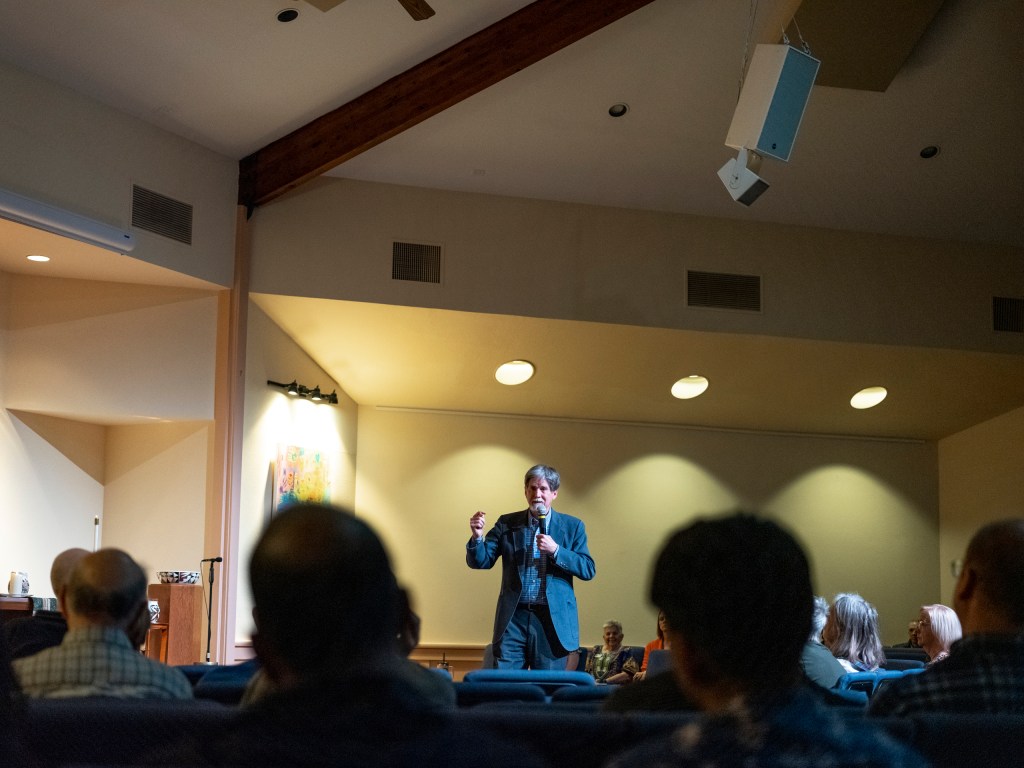
The first protest Talarico ever attended — as a fourth grader in Austin demanding then-Gov. George W. Bush support legislation making it easier to prosecute hate crimes — was with the church that would mold his faith and become his political North Star: St. Andrew’s Presbyterian.
Rev. Dr. Jim Rigby, Talarico’s pastor and the leader of St. Andrew’s, was put on trial by the Presbyterian Church (U.S.A.) for ordaining gay and lesbian clergy in the 1990s. In the 2010s, the church decided to house an undocumented mother and son from Guatemala facing deportation. Today, congregation members stand watch against federal immigration agents during the church’s semimonthly food pantry, and they maintain a “Field of Hope” that serves as a “visible symbol of our love for all people” and aims to “reclaim the cross from Christian nationalism.”
“Politics and religion and causing trouble all was very intertwined and synonymous for me growing up,” Talarico said.
Rigby baptized Talarico, married his parents and spoke at the invocation when Talarico was sworn into the Texas House. As a child in the St. Andrew’s day care, the longtime pastor recalled in an interview, Talarico broke up fights and acted as a “calming presence.” During sermons, he would “lean forward and pay attention in a way that’s kind of unusual for children.”
“I was brought up in a very countercultural faith that didn’t sound like everything I heard at school or at work or in the media,” Talarico said on The Ezra Klein Show last month. “Dr. Jim, my pastor, always said that religion shouldn’t lead to itself — religion should lead you deeper into your own life. To me, that is such a gift that you can give a young person.”
In an interview at the church’s library, which featured banned books like graphic novel “Persepolis: The Story of a Childhood,” Rigby said he doesn’t like theology. He avoids Christian prayers and creeds during his services to avoid excluding any non-Christians in the audience. And he sees Jesus as closer to a “loving atheist than an indifferent theologian.” His Christianity, he said, is defined by the “idea of putting compassion before everything else.”


That outlook is central to the St. Andrew’s tradition that has been foundational to Talarico’s politics and the ideals from which his campaign extends today.
“We are in the business of loving each other,” said Kelsey Black, a bookstore owner and member at St. Andrew’s. “It feels like all of Christianity is more concerned with their own salvation, and they allow the whole world to go to hell because of it. I don’t care about salvation. I don’t care if there’s a heaven, I don’t care if there’s a hell. I care that my neighbor needs help.”
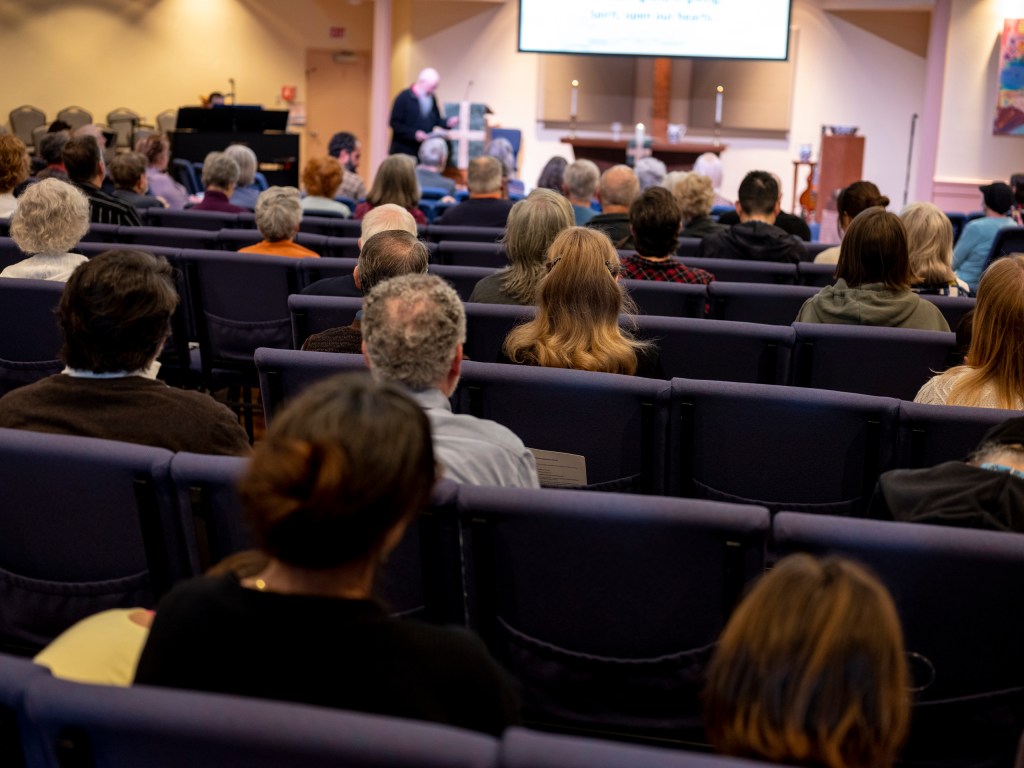
The service on a recent Sunday began with a puppet show for the many children in the congregation, featuring such characters as the Rev. Dr. Skunky — whom Talarico once played as a child — and Mr. Monkey.
“Is God hate, or is God love? Did Jesus tell us to judge each other or to forgive?” one of the puppets asked the children gathered. “In this church, we try to love everyone.”

Rigby led the over 100-person congregation in a song on the guitar, before launching into the day’s sermon, which was spun off the story of Cain and Abel and Cain’s question to God asking if he was his “brother’s keeper.”
“It is only empathy for people who are different from you that widens your world into a community,” Rigby said in the sermon, which had fewer references to Scripture than it did to today’s political climate. “So you have to answer that question: Are you your sister’s keeper? Are you your brother’s keeper? Are you the keeper of your human family?”
Later, in the benediction, Rigby told the congregation that “the world is a mess right now, and you can be an oasis in the storm.”
“We don’t have to wait for a better world to come along before we convene as agents of a better future,” he said.
To Jennifer Thrift, a St. Andrew’s congregant, Talarico’s involvement in the church is enough to win her political support.
“If I knew nothing about James Talarico, nothing about his voting record or anything else — if I just knew he was a member of this church, that would be enough,” Thrift said.
For Talarico, Jesus’ commandment to love one’s neighbor demands an economic system that rejects concentrated wealth and power, provides health care for all and abides by the separation of church and state.
“Right now, what you’ve got is people baptizing their partisanship and calling that Christianity, when in reality your politics should grow out of your faith — not the other way around,” Talarico said this month on The Late Show with Stephen Colbert.
Some conservative activists and GOP lawmakers serving alongside Talarico in the Texas House have condemned his progressive reading of Christianity as a perversion of Scripture and a heretical rendition of their tradition.
On the floor of the Texas House in 2021, Talarico said, “God is nonbinary,” a statement that seems destined to splash across Republican attack ads this fall if he wins the primary. It has already caught the attention of the Republican National Committee, which recirculated it on one of its social media accounts last month.
Talarico was drawing from Scripture to oppose legislation requiring students to play on K-12 sports teams matching their biological sex, reproaching his Republican colleagues for what he cast as twisting Bible passages “to justify hurting children” — “a special kind of sin.”
“God is both masculine and feminine, and everything in between,” Talarico said, citing a passage from the Book of Genesis. “Trans children are God’s children made in God’s own image. There’s nothing wrong with them, nothing at all.”
In a statement, Talarico said his speech was meant to be “a little provocative,” but his point was “not theologically controversial: that God is beyond gender.”
“As the Apostle Paul says in Galatians: ‘In Christ, there is neither male nor female,’” he said. “So if someone has a problem with that, they shouldn’t take it up with me, they should take it up with the Apostle Paul.”
In 2021, Republicans also bashed a prayer Talarico led at the start of a House session that drew from various religious texts outside of Christianity, such as the Torah and the Quran, calling it “pure and utter religious garbage.”
“I am disgusted such blasphemy was spoken in the chamber,” former state Rep. Jonathan Stickland, R-Bedford, said on social media. “Lord forgive us for turning our state over to this trash. Where are the bold followers of Jesus Christ?”
“I’m sorry my prayer offended you, Rep. Stickland,” Talarico responded. “Love feels blasphemous when you’ve been taught a religion of hate.”
Some Democrats, too, remain unconvinced by Talarico’s faith as a means to statewide victory, questioning whether it’s sufficient to take on the Trump administration and mobilize a base that is hankering for a fighter.
“You preach about love, but isn’t that just too weak for the moment that we’re in today?” an attendee asked Talarico at a campaign event in Laredo.
After a TikTok influencer accused Talarico of calling former congressman and 2024 Democratic Senate nominee Colin Allred a “mediocre Black man” — a claim Talarico disputes — Allred disparaged Talarico’s emphasis on his faith, saying, “You are not saving religion for the Democratic Party or the left.”
“We don’t need you,” Allred said. “You’re not saying anything unique.”
Talarico is making the case that talking about religion resonates with Texans of faith who lean right or have felt alienated from the Democratic Party — if not hardcore Republicans or conservative evangelicals.
“We will not defeat the politics of division with more division,” he said at his rally in Austin last week. “In my experience, when you extend an open hand rather than a closed fist, you’ll be surprised by who takes that hand.”
Having a Democratic candidate openly talk about his Christianity has also given voice to some on the left who have seen Republican officials dominate the religious conversation.
“I’m glad that we finally have a Democrat who’s not afraid to say, ‘I am a Christian, and this is what my Christianity tells me,’” said the Rev. Babs Miller, a leader at St. Andrew’s who served as one of Talarico’s references for seminary. “It’s taking a stand and making sure people realize that there is another message out there besides the Christian nationalist message.”
“We stay registered”
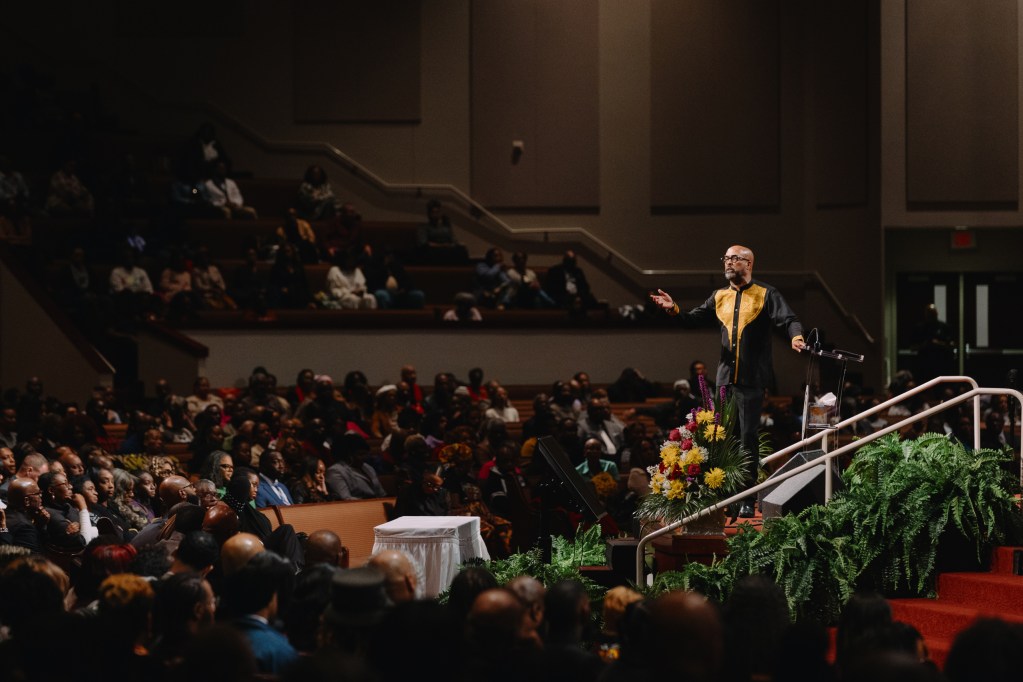
On the first Sunday of Black History Month, around 2,000 people filled the pews at Friendship-West Baptist Church for a service that broke down almost evenly between song — amped up by a five-piece band and leading choir of 30 — and sermon.
The church’s lead pastor, Frederick Haynes III, had just come from Minneapolis, where he spoke at a “night of healing” after the Trump administration’s immigration crackdown killed two American citizens and set off an explosion of backlash from local residents.
As he bounded back and forth across the platform at the front of the sanctuary, Haynes’ sermon that Sunday spanned fury over the “poisoned political climate we find ourselves in,” to the history of Black resistance from which the church should draw from to fuel its fight for justice today.
Friendship-West, Crockett’s home church, serves as a hub of Black voter mobilization. Alycia Branch, 27, remembers seeing Barack Obama become the nation’s first Black president at an election night watch party at Friendship-West in 2008, and again supporting Vice President Kamala Harris alongside the church in 2024.
“We can’t talk about the civil rights movement or even the abolitionist movement without looking at how Black churches especially mobilized congregations to make a difference,” Haynes said in an interview, noting, for instance, how Hope Street Baptist Church served as the organizing epicenter of the Montgomery bus boycott in 1955.
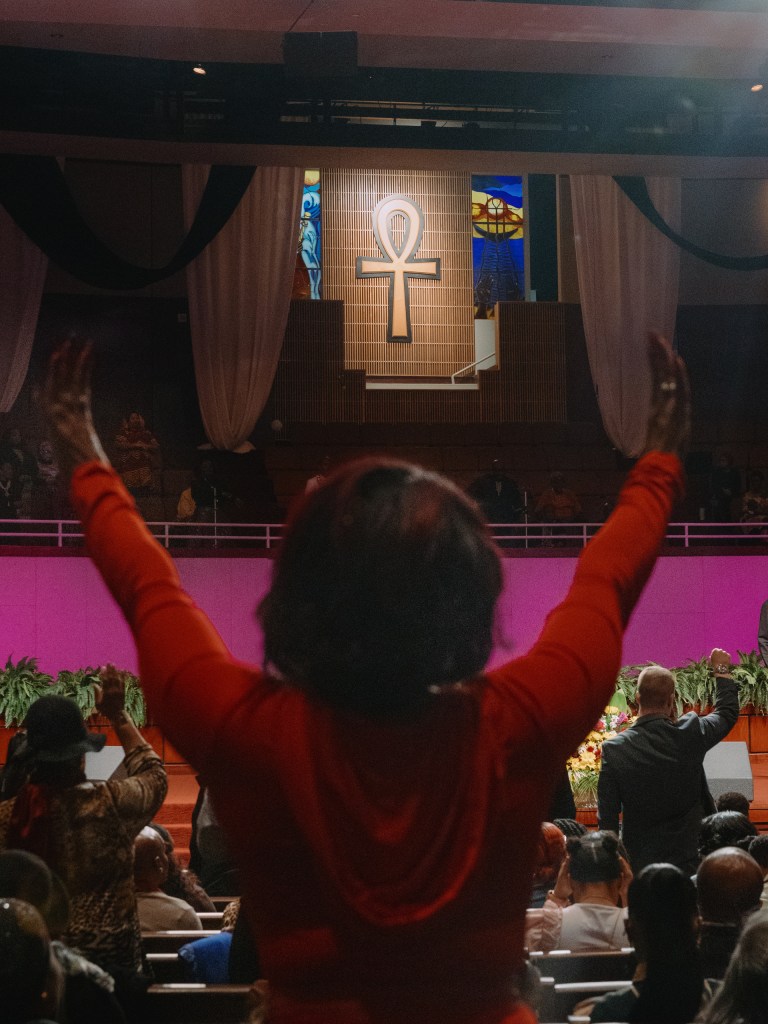

In her Senate bid, Crockett has sought to continue that tradition, holding packed events at predominantly Black churches and benefiting from the political organizing power inherent in places like Friendship-West, where Haynes said there is a “commitment to worshiping Jesus and fighting for justice. We believe they go together.”
At the recent Sunday service, outside the sanctuary, members of the congregation scanned a QR code and filled out forms to register to vote or check their registration status. “Black voters matter,” read a cardboard fan lying on the table.
“We stay registered,” Betty Freeman, 57, said when reminded of the upcoming deadline beneath a banner on the wall that overlaid the opening words of the Constitution’s preamble — “We the People” — with images of civil rights protests and Black freedom figures like Martin Luther King Jr. and Harriet Tubman.
Haynes, who is running for Crockett’s congressional seat, said he was glad to see Christianity become a greater part of the conversation among Democrats.
“When I hear Talarico speak, I hear someone whose faith is embracing of the other, whose faith is concerned about those who are impoverished and left behind,” Haynes said. “And when I see Jasmine Crockett not only articulating that justice is the value system I have rooted in my faith, that lets me know that faith can be something positive for the well being of the whole of the country, even if you don’t believe what we believe.”
Crockett, in an interview, said she had served as a surrogate for Democratic candidates around the country at Black churches “more often than not,” calling the church the source of her “moral compass” as a child and a “natural organization” to support Black civic engagement.
“When you think about politics and faith and Black folk, it all intertwines. It’s no different for me as a little Black girl that grew up in the church,” she said.

Crockett’s mom texts her prayers or Bible verses every morning, and she was part of the church choir growing up and while in law school. Today, the church is where she goes for a reminder of “the triumph of the people” over injustices of the past. She often leans on a passage from Psalms: “Weeping may endure for a night, but joy comes in the morning.”
Still, while she personally draws on her religious upbringing, the church less so defines her political identity than it represents a path for her to electoral victory. In the pews, she has found an audience of Black primary voters eager to support her less because of her faith than for her proclivity for fiery retorts against her Republican colleagues.
“The way that my tongue works — that doesn’t come out of the Bible per se,” Crockett said. “My litigation skills have allowed me to really hone in and be quick on my feet.”
When Crockett referred to former U.S. Rep. Marjorie Taylor Greene as having a “bleach-blonde bad-built butch body” after the Georgia Republican jabbed at Crockett with an insult about her false eyelashes, Haynes said he “was drinking some water, and it all came out.”
He called Crockett, who later returned his call and said, “Pastor, I’m not going to let them run over us.”
“I’m not going to let them run over me, I’m not going to let them run over our community,” Crockett said. “I’m going to fight back.”
This article first appeared on The Texas Tribune.