UT Tyler Awarded $219k for Pulmonary Fibrosis Treatment
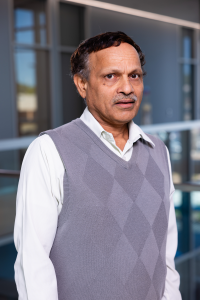
Dr. Sreerama Shetty
TYLER, Texas (June 23, 2025) – The University of Texas at Tyler received a $219,000 grant from the National Institutes of Health to fund a project led by Dr. Sreerama Shetty, School of Medicine professor of cellular and molecular biology. Shetty, in collaboration with MD Anderson Cancer Center and the National Cancer Institute, will use the funding to study the potential of treating pulmonary fibrosis, or lung scarring, from radiation with a particular peptide developed in Dr. Shetty’s Lab.
“This grant reflects the kind of impactful, collaborative research we’re committed to at UT Tyler,” said Dr. Sue Cox, School of Medicine dean. “Dr. Shetty’s work could lead to life changing treatment options for patients facing pulmonary fibrosis, especially those undergoing cancer therapies.”
The first peptide developed in Shetty’s lab, CSP7, also called LTI-03, is currently undergoing phase 2 clinical trials in patients with idiopathic pulmonary fibrosis as a potential treatment for various forms of the condition.
According to the U.S. Centers for Disease Control and Prevention, the median survival for pulmonary fibrosis after diagnosis is three to five years.
“The survival rate after five years is 20%,” said Shetty. “Previously, we’ve studied how these peptides can be used to treat fibrosis from smoking or exposure to silica through work in construction, fracking, mining or manufacturing. Now, we are learning that these peptides have the potential to treat fibrosis from radiation—and even prevent it.”
Radiation is often used in the chest area to treat breast and lung cancer, which can cause lung fibrosis. While radiation is used at lower levels to minimize lung damage, this can result in missing some of the more resistant tumors which may spread aggressively at a later point. These peptides can be used to not only prevent pulmonary fibrosis but to allow higher radiation levels, ensuring that the most resilient cancer cells are destroyed without compromising long term lung function.
Shetty joined the UT Tyler Health Science Center in 1993. He has since obtained nine patents and published more than 100 papers with colleagues, his research focusing on chronic lung diseases. and few others have been licensed to a newly founded biotech startup for commercialization.
With a mission to improve educational and health care outcomes for East Texas and beyond, UT Tyler offers more than 90 undergraduate and graduate programs to more than 10,000 students. Through its alignment with UT Tyler Health Science Center and UT Health East Texas, UT Tyler has unified these entities to serve Texas with quality education, cutting-edge research and excellent patient care. Classified by Carnegie as a doctoral research institution and by
U.S. News & World Report as a national university, UT Tyler has campuses in Tyler, Longview, Palestine and Houston.